Goal: learn to play Bella Ciao on a 17-tine instrument, starting with a simple version and moving on to more musical rhythmic variations.
This page guides beginners step by step. Start with tuning and finding your way around the tines. Then explore three ways to read the music: numbered notation, letters (C D E…) and tablature for greater precision.
The method follows a clear progression: prepare the instrument, memorize the melody, steady the rhythm, build speed cleanly, then refine your playing with tablature.
Expected result: play a recognizable tune, vary the tempo without losing note clarity, and learn a little about the song’s Italian origins and its connection to the series “La Casa de Papel.”
Practical and concrete, this article includes practice tips, octave markers, and advice on rests and articulation.
Prepare your kalimba before playing “Bella Ciao”
Before you play, prepare your instrument so the notes are in tune and the sound is clear.
A quick three-minute routine: check the tuning, identify the tines, then briefly review the notation conventions. This keeps you from learning the melody on an out-of-tune instrument.
Check the tuning
Listen to each note: a muddy sound or audible beating can indicate that it is out of tune. A simple adjustment with a tuner immediately improves the sound.
Find the tines and notes
On a 17-tine model, the fan-shaped layout places the central tines at the heart of the melody. Use stickers or engravings as guides during your first practice sessions.
Review the reading basics
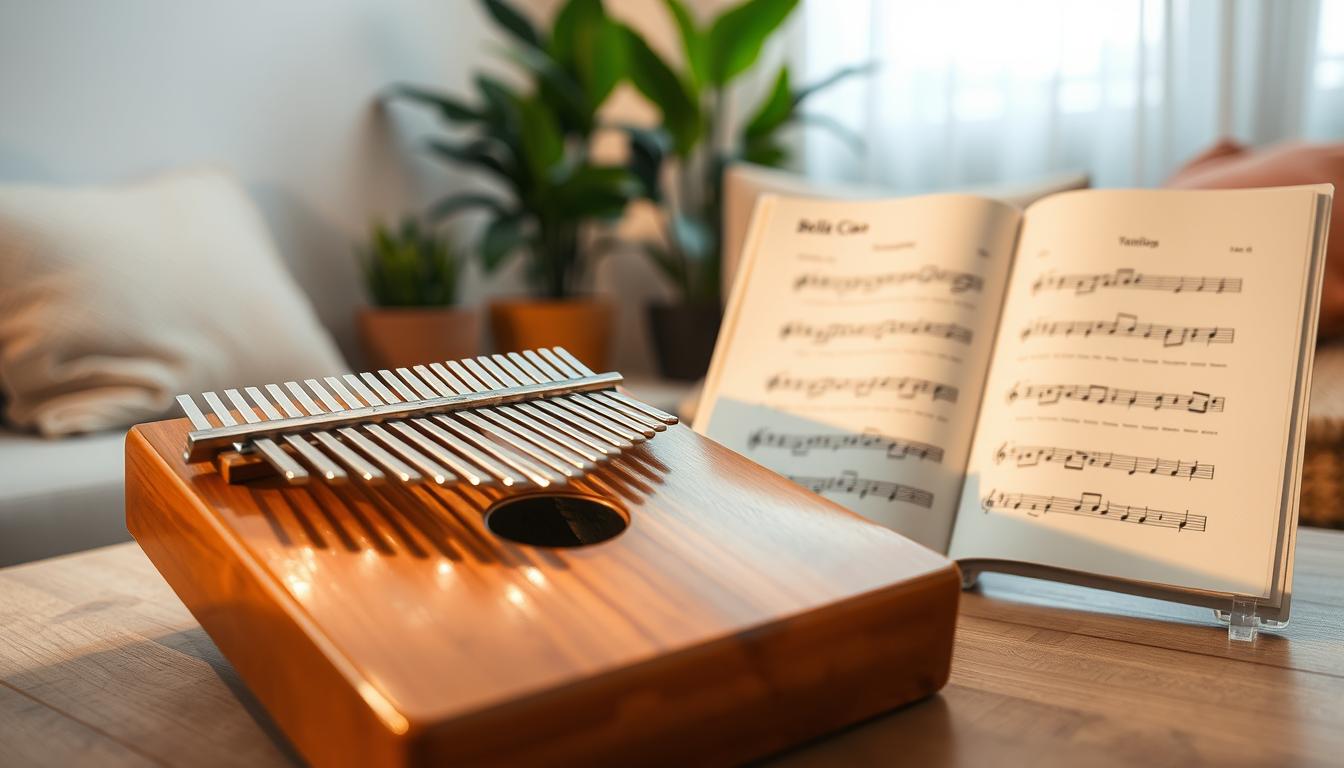
Simplified sheet music gives the order of the notes; tablature shows their duration and the rests. These forms of notation can also help you check a melodic phrase on other instruments, such as the piano.
- Method: play very slowly and check every note.
- Once the notes are clear, work on playing smoothly.
Bella Ciao on kalimba: easy sheet music and tempo variations
To get comfortable with the instrument quickly, practice short numbered patterns divided into phrases.
Numbered notation: short version
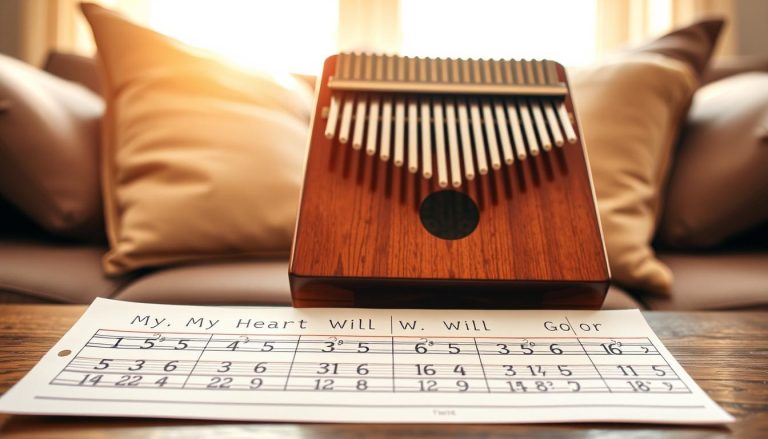
Getting-started version: follow scale degrees 1 to 7. For example:
3 6 7 1* 6 3 6 7 1* — break the passage into (3 6) (7 1*) (6 3). Play each group slowly.
Letter notation
If your tines have letter labels, convert the notes as needed. For example, for the same passage:
C D E F becomes C E F G, depending on your instrument’s layout.
Conversion and octaves
| Numbers | Solfege | Letters |
|---|---|---|
| 1 | Do | C |
| 3 | Mi | E |
| 7 | Ti | B |
A dot above a note indicates the higher octave. Ignoring this marker changes the melodic line.
Parentheses indicate notes played together or as a glissando, depending on the effect you want. To check your playing, go very slowly, sing the phrase in your head, then increase the speed once the notes are clear.
For more complete kalimba sheet music, see this resource.
Master rhythm and tempo variations to capture the sound of “La Casa de Papel”
Finding the right pulse turns a simple melody into a lively piece. The two-beat feel is easy to count: 1-2, 1-2. This sway gives the tune momentum, even if you have little knowledge of music theory.
Understand the two-beat feel
Count quietly while playing each note on the first beat. On the second, let it ring. This alternation keeps the pulse steady and brings out the sequence of notes.
Choose a starting tempo, then speed up
Start slowly, with a metronome set to around 60 to 70 BPM. Aim for clarity before speed. To play faster, increase the tempo in steps: repeat the same phrase five times without a mistake, then raise the tempo by 5 BPM.
Place rests and breaths
Lift your thumbs slightly to let notes ring, then stop the sound cleanly when a pause is needed. These breaths give the melody shape and keep the notes from running together.
Practice with a cover
Choose a video tutorial that shows the tempo, accents, and pauses. Imitate its energy and phrasing without trying to copy every detail exactly.
Mini-routine: two minutes keeping the pulse, five minutes playing phrases slowly, and three minutes at your target tempo. This practice steadies the melody and makes it easier to share with others.
Use kalimba tablature for a more precise performance
Tablature shows what a simple line of notes leaves out.
Why tablature helps with note lengths and rests
Tablature shows more than the order of the notes: it also indicates how long they last and where to pause.
This makes the rhythm easier to read when you want a more musical performance. Parentheses often indicate chords or a glissando that adds color to the phrase.
How to read tablature: find the tine and note length
Start by identifying the tine to play and how long to hold the note. A line or dot indicates whether to sustain or stop it.
Anticipate the rests so you do not interrupt the pulse. This visual approach also helps beginners on other instruments.
Adapt your fingering and transitions on steel tines
Alternate your left and right thumbs to maintain speed and avoid tension. Identify recurring passages and make the movements automatic.
On steel tines, consistent fingering reduces mistakes and produces a result closer to what you would achieve on the piano.
Tips to avoid catching the tines and play more smoothly
Trim your nails slightly, pluck the tines at an angle, and relax after each note. Quietly reposition your thumbs during long notes.
Practice one measure at a time: isolate a difficult transition, repeat it, then put it back into the phrase. The aim is a more precise, musical version without speeding up unintentionally.
Understand the history of “Bella Ciao” and why the song spread around the world
From a work song to a symbol known worldwide.
The tune has roots among the mondine, women who worked in the rice fields of the Po Valley. They sang to ease their fatigue and demand better working conditions.
During World War II (1943–1945), new lyrics linked the melody to the partisans and the Resistance. The writers often remain anonymous; the simple verse structure makes the words easy to remember.
- Spread: a performance in Prague in 1947, a 1963 television appearance by Giorgio Gaber, then waves of covers by Modena City Ramblers, Banda Bassotti, Ska-P, and Chumbawamba.
- Symbol: an antifascist anthem for some and a universal song of liberation for others.
The series La Casa de Papel brought the song back into the spotlight: the Professor teaches it at key moments (season 1, episodes 11 and 13), sparking renewed worldwide interest in 2018.
Knowing this context helps you play with intention. To explore further, see this tablature resource, which connects the history to musical practice.
Conclusion
To finish, a clear progression takes you from basic movements to expressive playing. Start with simple sheet music, steady the rhythm, then work on precision using tablature and rests.
Tip: a tuned instrument and clear notes immediately improve your sound, even at a slow tempo. They also improve the quality of the music you share.
Practice briefly but regularly: ten minutes a day on the same phrase is better than an occasional long session. Try playing the melody at two tempos—first slowly, then closer to the cover’s pace—without losing the steady pulse.
Keep the sheet music handy, printed or as a PDF, and try a variation once you have mastered the simple version. Understanding the song’s meaning strengthens your interpretation and helps explain why it resonates around the world.