What you will learn: how to play this iconic song step by step using an easy-to-read notation and ready-to-use tabs. This guide is for beginners, people returning to the instrument after a break, and players with a 17-tine kalimba (adaptations for 21- and 34-tine models are included).
You will find tabs and an explanation of their symbols, followed by a gradual approach to practising rhythm, alternating thumbs, and expression. Each musical phrase is broken down to help prevent common mistakes, such as notes overlapping.
Added benefit: understand numbered notation and how it relates to solfège and letter names, so you can transfer the melody to other instruments, such as the piano. This complete tutorial takes you from understanding to playing to practising.
For more resources and advice about the instrument, visit our kalimba section.
Understand the song and kalimba notation before you play
Let’s start with why this theme works so well on melodic instruments.
Musical background: released in 1997 for the film Titanic, performed by Céline Dion, and written by James Horner and Will Jennings, the song has a melody that builds gradually. Simple and lyrical, it suits both the central and outer tines of the kalimba because it moves between registers and repeats musical patterns.
The essentials of numbered notation
In C major, the numbers run from 1 to 7 (1 = C). Knowing this foundation helps you understand what you are playing instead of mechanically copying a string of numbers.
| Solfège | Letters | Numbers |
|---|---|---|
| Do | C | 1 |
| Re | D | 2 |
| Mi | E | 3 |
| Fa | F | 4 |
| Sol | G | 5 |
| La | A | 6 |
| Ti | B | 7 |
Octaves, chords, and conversion
A mark above a number (for example, 1′) indicates the higher octave. On a kalimba, lower notes are often on the central tines and higher notes on the outer tines.
Parentheses indicate notes played together (a chord or slide). For a clean glissando, slide your thumbnail along the tines without catching their edges.
Conversion and checking: if the arrangement does not suit your instrument, a tab converter can turn numbered tabs into solfège or letter names and help you transpose the piece. Read a passage in numbered tabs, then check it on a piano to confirm the pitches.
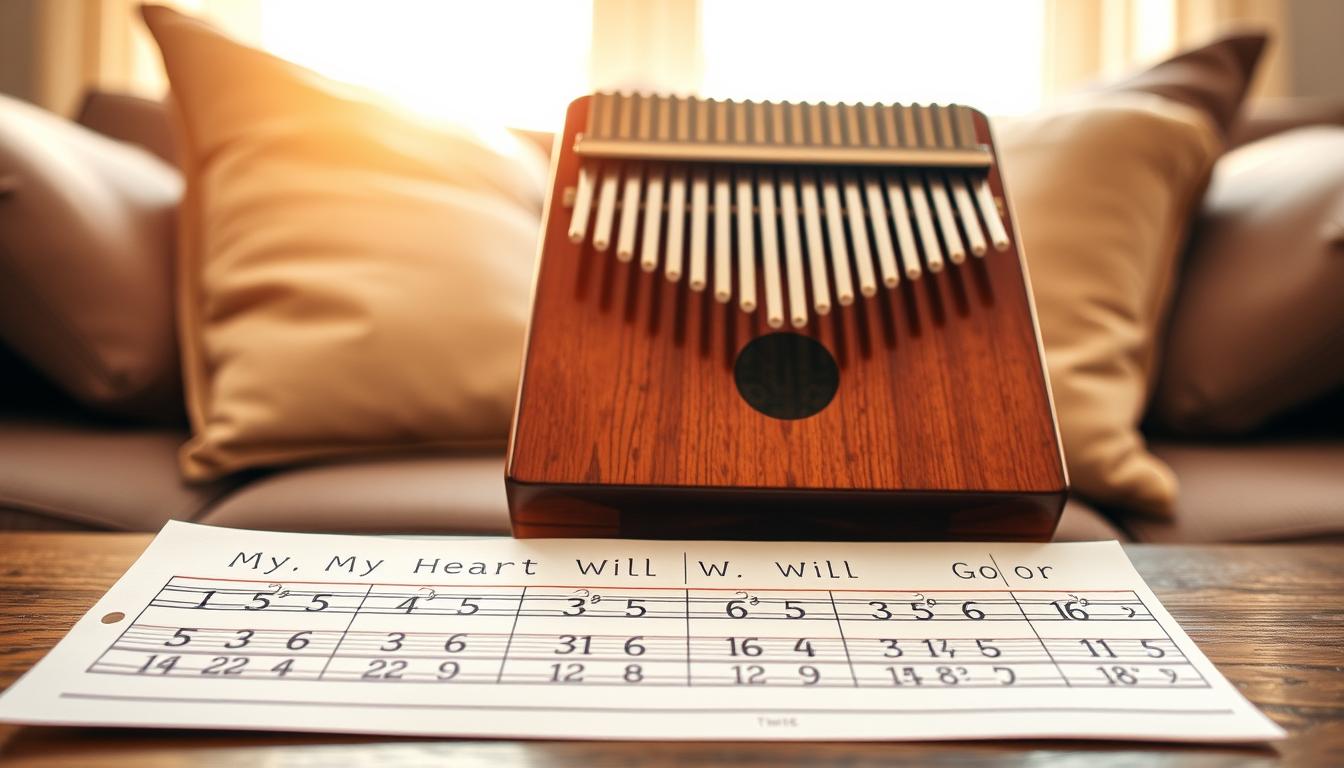
The next section takes you through the melody phrase by phrase, with measure markers to make learning easier and avoid overly long sections. For a ready-to-use score, see this tab sheet.
My Heart Will Go On on kalimba: easy numbered notes
Start with short, clear phrases so you can learn the melody without losing your place.
Here is a version ready to play, divided into short musical phrases. Sample excerpt: 1′ 2′ 3′ / 2′ 1′ 2′ 5′ / 4′ 3′ 1′ / 6 5 …
Understand the playing symbols
- Long notes: show their duration with a “~” after the note (for example, 3~) and let the tine vibrate.
- Rests: lift your thumb to stop the sound and keep the beat.
- Glissando or slide: use parentheses for chords or sweeps (for example, (1′ 3′)).
Adapt the key to your instrument
If your kalimba has standard C tuning and 17 tines, play the melody as written. On a 21- or 34-tine model, choose the octave that preserves the melody’s lyrical quality and transpose if necessary.
| Model | Range | Tip |
|---|---|---|
| 17 tines | Standard C major | Play in the central position without transposing |
| 21 tines | Extended range | Choose a higher or lower octave to suit the melody’s range |
| 34 tines | Very wide | Transpose to avoid notes that are too high |
Checking mistakes: if a note sounds wrong, check the octave (1 or 1′) before assuming the instrument is out of tune. Play the melody alone first, then add the notes in parentheses once your rhythm is steady.
Tutorial: how to play My Heart Will Go On on kalimba (beginner method)
First, hold your hands in a stable position so you can play evenly and clearly.
Thumb position and alternation for a flowing melody
Holding the instrument: rest the kalimba against your palms and relax your wrists. Pluck the tines gently with your thumbs for a clear sound.
Alternation: alternate between your right and left thumbs, as you would alternate hands on a piano. This prevents your playing from getting stuck and keeps the melody flowing.
Practise slowly with a video guide
Use slowed-down tutorials and practise in two-measure loops. Repeat each loop 10 to 20 times before moving on to the next.
For visual examples, explore a gallery of covers and tabs on Pinterest kalimba.
Bring out the emotion: vibrato, resonance, and dynamics
To create vibrato, move your thumb very slightly or let the body of the instrument vibrate. Allow notes to ring without damping their resonance.
Emphasize the high points to give the melody shape.
A gradual practice plan and common mistakes
Warm-up: play the C major scale and octave jumps (1 ↔ 1′), then focus on the faster passages.
| Exercise | Duration | Goal |
|---|---|---|
| C major scale | 5 min | Thumb agility |
| Octave jumps | 5 min | Right- and left-hand coordination |
| Two-measure loops | 10 to 15 min | Make the rhythm feel automatic |
- Tempo drifting → use a metronome.
- Notes blurring together → check your plucking angle and nails.
- Nails getting in the way → file them to create a clean edge.
Use an enhanced digital score
Scan the QR codes to access a video demonstration and audio accompaniment. Print the PDF or follow the track on a tablet while you play.
Final tip: use the same method for other popular songs, such as “Can’t Help Falling in Love,” Christina Perri’s “A Thousand Years,” “You Are My Sunshine,” or “River Flows in You,” to stay motivated.
“Slow, repeated practice always pays off: a passage you have mastered becomes a musical phrase.”
Conclusion
Finish with a practical plan to strengthen what you have learned.
Understand the notation (octaves and parentheses), read the tab phrase by phrase, and follow the beginner method: work on your thumb technique, play slowly, and add expression. Start very slowly and increase the tempo only when the transitions are clean.
Next step: play the song once a day, repeating short loops. Pay attention to dynamics and resonance to capture the emotion without overloading the melody.
To vary your repertoire, try familiar pieces such as C418’s “Haggstrom” from the Minecraft soundtrack, a theme from the Howl’s Moving Castle soundtrack, or “Hedwig’s Theme” from Harry Potter. Make a short playlist of 3 to 5 pieces and break each one into phrases.
If a note lies outside your instrument’s range, use a transposition tool or change octaves rather than giving up. The goal is to make the instrument accessible, musical, and rewarding to play.