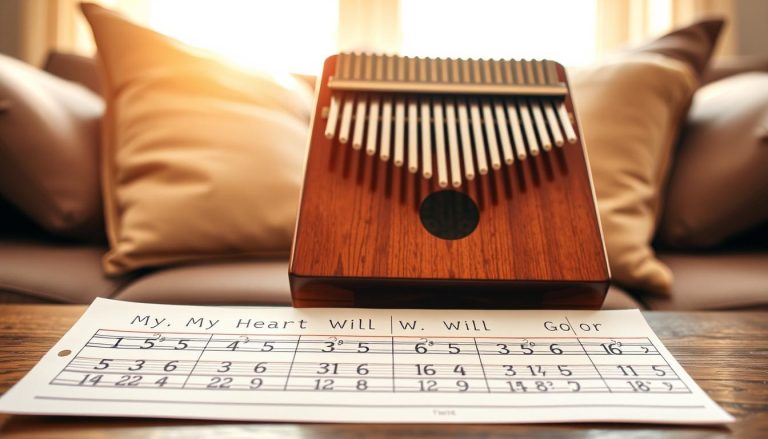
Goal: provide a clear tutorial for playing this famous piece on the kalimba. The aim is to make the sheet music easy to read and give precise guidance for your thumbs.
Composed by Yiruma in 2001, the piece was written for piano. Its fast passages call for a methodical adaptation to make playing smoother and more comfortable.
What you will find: ways to read the music (numbers, letters and tablature), conventions for octaves and chords, and a step-by-step method for mastering the fast passages.
Expected level: approachable with regular practice. Keep a steady rhythm and tune the instrument carefully so you can identify the notes correctly.
Practical benefits: play without extensive music-reading knowledge, improve your sound through tuning and develop a more relaxed technique. Save the supplied PDF for offline practice.
Before playing River Flows in You on kalimba: prepare your instrument and choose how to read the music
Before touching the tines, prepare your instrument and choose how you will read the music. A quick check prevents mistakes and saves time.
Understand how to read music for the thumb piano and spot common pitfalls
Visual conventions: look for dots that mark octaves, parentheses that indicate chords, and connected groups of notes. These signs can change how you divide the notes between your hands.
Choose between sheet music, simplified notation and tablature
Traditional sheet music helps you remember the harmony. Simplified notation lets you get started quickly. Tablature makes it easier to find the tines and read at a glance. Choose the format that feels most comfortable.
Tuning routine and note checks
Before each session: check the standard tuning (C major on a 17-key kalimba), prioritize the tines you will use most, and correct any discrepancies immediately. An in-tune instrument helps develop your ear.
Plan for difficult passages and organize your practice
The piece contains fast sequences and repeated patterns. Practice with a metronome, break difficult passages into smaller sections, and place markers on the instrument to guide your thumbs.
| Element | Recommended action | Frequency |
|---|---|---|
| Tuning | Check and adjust the low and high tines | Before each session |
| Reading symbols | Check octaves and chord groups | On the first read-through |
| Methods | Choose sheet music, tablature or simplified notation according to your goal | Before learning a passage |
For more resources and lessons, visit our kalimba tutorial site.
River Flows in You on kalimba: accessible sheet music and fingerings
A few visual cues make it easier to move between numbers, letters and octaves.
Read numbered notes
Scale degrees 1 through 7 correspond to C through B. A dot above a number indicates the higher octave.
Method: look ahead to the notes in the next measure so you can anticipate what comes next and keep the music flowing.
Read letter notation
Letter notes (C, D, E…) suit musicians who already know this system. Use the small table below to move quickly from C to 1.
Useful equivalents
| Solfege | Letter | Number |
|---|---|---|
| Do | C | 1 |
| Re | D | 2 |
| Mi | E | 3 |
| Fa | F | 4 |
Tablature for 17 keys and fingerings
Tablature shows the central and outer tines. Practice balanced movement between your left and right hands.
For fingerings, keep your thumbs relaxed, pluck the tines briefly and control the rebound. Anticipate thumb alternations for cleaner playing.
Chords, glissando and saving the music
Parentheses indicate notes played together; use both thumbs or play a glissando where indicated.
Save the PDF for offline playing and print it if needed. For more resources, see our kalimba tutorials.
Learn faster: a practice method using a video tutorial and practice tips
A good video makes learning easier. Watch it first to observe the hands, then listen without playing to memorize the musical phrase.
Use a video to identify when to pluck each tine
Follow three steps: watch, imitate each phrase after hearing it, then play while following the sheet music. This method helps you identify exactly when to play each tine.
Practice in sections
Separate the introduction, main theme and transitions. Practice the right and left hands separately, then combine the parts slowly to reduce mistakes.
Steady the rhythm and avoid tension
Start very slowly and aim to play each note cleanly before speeding up. Increase the tempo in stages (for example, by 5 bpm). Count quietly, use a metronome and mark the strong beats.
Practical tip: alternate between reading the tablature and playing from memory. Memorize recurring patterns, then return to the sheet music to correct octave details. Remember that adapting the piano original brings some arpeggios closer together; prioritize musical expression over speed alone.
For more rhythm tips, see this guide to rhythm and strumming.
Conclusion
In short, preparation, repetition and careful listening are the keys.
Practice plan: check the tuning, choose a suitable format (simplified notation, letters or tablature), identify octaves and chords, then practice progressively with a metronome.
Success depends on regular practice in short sections, so you can master the fast sequences while keeping a clean sound.
Keep an offline copy of the PDF so you can practice anywhere, and take care of your instrument and your touch to produce a beautiful sound.
To continue learning, explore more resources and sheet music for 17-key kalimba on our site.
Key phrase: River Flows in You on kalimba: accessible sheet music and fingerings — work on dynamics, consistent touch and clear chords to make the piece expressive.