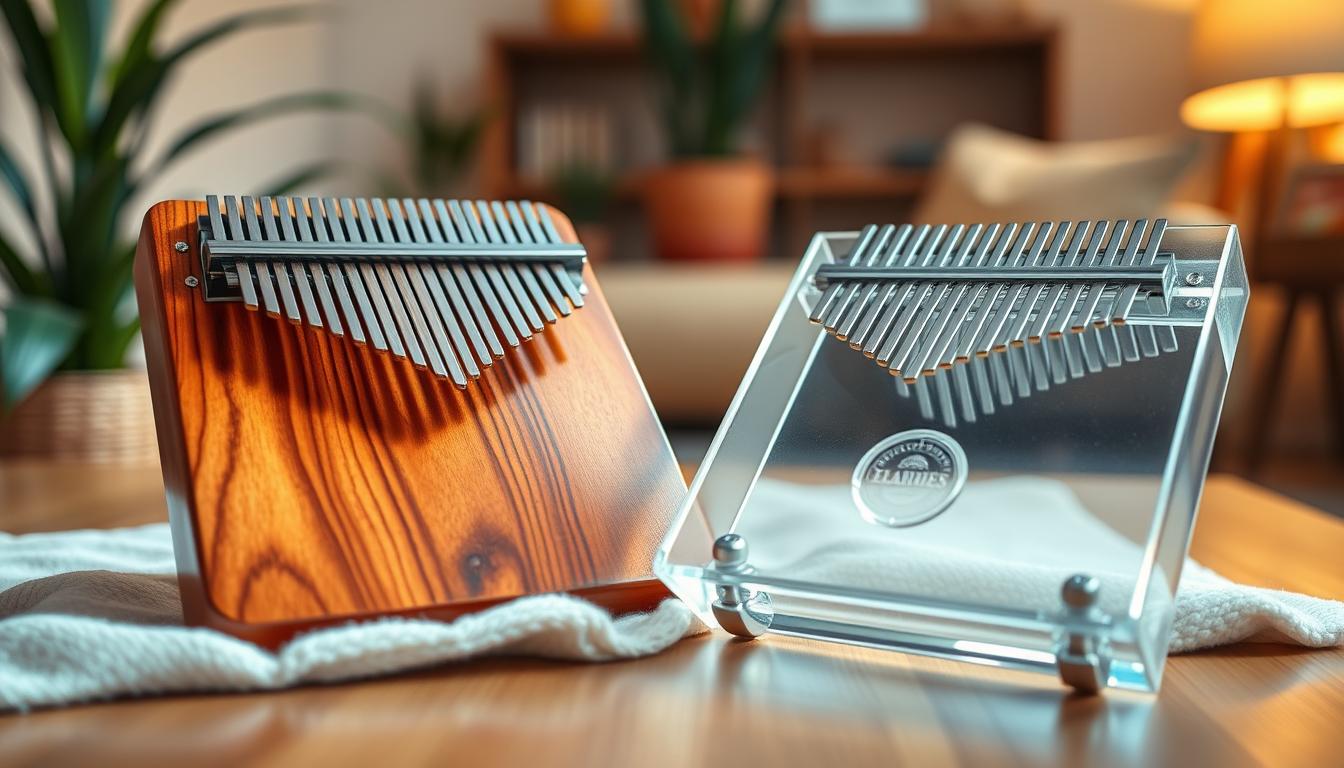
What this article covers: a comparison of two main types of kalimba to help you decide which best meets your needs for tone, volume, resonance, comfort, care and budget.
Important: there is no single right answer. Your choice depends on your musical style, where you play (alone, with family or for a small audience) and your taste in design.
We begin with the technical factors: sound character (warm and rich or clear and crystalline), projection, the presence of a resonator box and how easily the tines vibrate without making you pluck them forcefully.
Most transparent models have a “flat” body. This design strongly affects volume and the range of possible effects, beyond the material itself.
We will then examine resonance, sustain, effects (vibrato and wah-wah), ergonomics, durability, care, price, accessories and environmental impact.
For a complete buying guide and concrete examples, see our dedicated wood versus acrylic comparison.
Understanding the materials: PMMA and natural wood
To understand the differences in tone, let us first define the materials and their properties.
PMMA (acrylic glass or Plexiglas) stands for polymethyl methacrylate. It is transparent, very smooth and glossy. It resists UV light and corrosion well.
Valued for its modern appearance, PMMA is rigid and holds its shape. It ages without cracking easily, but its surface readily develops fine scratches. Technically, it is a petroleum-based plastic.
The role of the material in a tine instrument is not to create the note: the tines determine its frequency. The box or solid body does, however, change how their vibrations travel.
The audible result changes: tone, attack and playing feel all differ. The material affects how you perceive the notes more than their pitch.
Why wood remains a benchmark: this natural material transmits vibrations in a more organic way. Its harmonics can seem richer, and it often feels warmer to the touch.
Finally, “wood” covers several species. Their density and hardness vary and affect the quality of the resonance.
For more detail, see our comparison of materials, which examines their sound and the effect of resonator boxes.
Choosing a kalimba: wood or acrylic, which sounds better?
You hear a sound’s character in its attack, harmonics and note duration: these qualities become apparent from the first few notes.
Sound character
Warm, rich sound: the traditional material produces rounded, full notes. Repeated patterns sound more songlike, and the texture gives melodies body.
Clear, crystalline sound: the modern model favors distinct notes. Its attacks are pronounced, and its clarity brings out delicate patterns.
Resonance and sustain
Resonance is the way vibrations spread and fill a space. Sustain describes how long a note remains audible.
A resonator box amplifies the decay of a note; a flat block produces shorter sustain and a drier sound. Tuning and tine quality can narrow or widen this difference.
Styles and uses
For lullabies and calm atmospheres, clarity and softness can be soothing. For lively pieces or pop melodies, harmonic richness can bring out familiar tunes.
| Characteristic | Warm sound | Clear sound |
|---|---|---|
| Note texture | Rounded and rich | Distinct and bright |
| Resonance and sustain | Longer and fuller | Shorter, with a dry sound |
| Recommended uses | Pop melodies, lively patterns | Lullabies, gentle atmospheres |
| Expression and effects | Richer effects with a resonator box | Clear attack, fewer effects |
Volume and projection: the impact of a “hollow” or “flat” design
The presence or absence of a resonator box dramatically changes how an instrument fills a room.
Hollow kalimba
Models with a cavity have a resonator box that naturally amplifies the sound. They sound fuller, with more prominent low notes, without requiring you to pluck harder.
Players often feel the vibrations in their palms. The sound seems “bigger” and carries across the room.
Flat kalimba
“Flat” models are quieter. This format suits late-night playing, apartment living and intimate sessions.
Why acrylic is often “flat”
Transparent models favor a flat shape for its appearance and ease of manufacture. “Hollow” plastic versions exist but remain less common.
Tine pressure and fatigue
Some models need a firmer pluck to produce a sound. This can tire your fingers and pose a problem for beginners without long nails.
Practical rule: first decide whether you need a resonator box. This factor affects volume more than the material itself.
Possible sound effects: vibrato, wah-wah and soundhole techniques
The holes and cavity of a resonator box enable effects that add expression to musical phrases. These techniques are easy to learn and produce expressive results.
Vibrato using the rear holes
Quickly covering and uncovering the rear holes changes the resonance of the box. The result is an audible variation in the note, similar to a controlled tremble.
This is useful for making a slow melody “breathe” or marking the end of a phrase.
Wah-wah effect using the central soundhole
The central soundhole allows more pronounced modulation. Gradually covering it creates a wah-wah effect that can emphasize a chorus or build intensity.
Limits of “flat” models
Transparent models are often “flat” and lack a suitable cavity. Without a soundhole, these effects are difficult to produce; expression then depends on attack and rhythm.
For example, if you want to learn expressive techniques and develop more creative kalimba playing, choose an instrument with a resonator box. For a detailed guide, see our wood versus acrylic comparison.
Design, comfort and ergonomics: a kalimba you will want to pick up
An attractive instrument invites regular practice. Its appearance and feel affect how much time you spend playing, much like a practice piano you enjoy opening.
Traditional appearance
Wood appeals through its grain and variety of species. Mahogany is common, while black walnut gives a darker look. Satin or varnished finishes change both its feel and appearance.
Modern appearance
Acrylic offers distinctive designs: transparency, a “rainbow” effect or animal shapes. It is highly decorative and often chosen as a gift.
Weight and ergonomics
Weight affects wrist fatigue. A few hundred grams can become noticeable after 30 to 60 minutes. Rounded edges and a grippy surface help prevent pressure points.
A simple criterion: for long sessions, favor a light, comfortable instrument over appearance alone.
| Criterion | Traditional advantage | Modern advantage |
|---|---|---|
| Feel | Warm, good grip | Very smooth |
| Weight | Often lighter | Sometimes heavier |
| Appeal of playing | Looks like an instrument | Decorative appearance |
Care, strength and lifespan: which material stands up better to daily use?
Daily use soon reveals whether an instrument stays attractive and reliable after weeks of transport and playing.
Caring for wood: protect it from moisture and temperature swings. Avoid prolonged sun exposure. Periodically treat the surface with a suitable oil or check the condition of its varnish.
Acrylic or PMMA: this stable material needs little care. It resists UV light, corrosion and minor knocks. Its glossy surface, however, quickly shows fine scratches.
Which should you choose for travel or a child?
For frequent travel or a young musician, prioritize durability: transparent plastic or hard woods such as acacia, padauk and sandalwood.
Important reminder: lifespan also depends on tine quality and proper tuning, not just the instrument’s body.
| Aspect | Wood | Acrylic |
|---|---|---|
| Care | Oil or varnish, careful storage | Simple cleaning, little maintenance |
| Resistance | Varies by wood species | Stable; resists UV light and corrosion |
| Appearance over time | Warm patina if properly cared for | Fine scratches visible on the glossy surface |
If you want practical examples and models suited to your needs, see our section on variations and reviews and our instrument comparison to refine your choice.
Budget and value: what you are really paying for
Before buying, understand what the price actually covers.
What you pay for: the material, how the body is made, tine quality, tuning accuracy and finish.
Each factor affects sound quality and lifespan.
Good tuning and well-finished edges often make the difference between enjoyment and frustration.
Prices by wood species and market position
Consider
mahogany, which remains an accessible and popular choice.
More prized woods, such as black walnut, raise the price noticeably.
Depending on its design, acrylic often sits at a similar price point to wood on the market.
Elaborate models may cost more despite being made of plastic.
A realistic starting budget
As a starting guide, aim to spend €30 to €50 on a reliable instrument.
Beware of very cheap offers: tuning accuracy and finish are often compromised.
Prioritize quality over the brand alone.
Check the brand and model names to assess their reputation and whether support is available.
Essential accessories
- Tuning hammer: lets you quickly correct an out-of-tune tine.
- Note stickers: make notes easier to read and remember.
- Case: protects the instrument in transit.
- Booklet or other resources: help you get started and improve, as with the piano.
Buying strategy: if your budget is tight, invest first in a quality body and tines and a tuning hammer before paying extra for a premium design.
For practical benchmarks and comparisons, see our price guide.
“A good instrument begins with a well-made body and stable tines.”
Which kalimba suits you? Beginners, developing players, gifts and different uses
To choose efficiently, start by identifying your needs. Are you a beginner, an improving musician or looking for a gift? Each calls for different priorities.
Beginners: why favor wood
For beginners, a wooden instrument has an advantage. Its tines take less effort to make them resonate, and it produces a pleasant volume, especially in a “hollow” design.
Number of tines: aim for 10 to 17
The first criterion is the number of tines. Aim for 10 to 17 keys; 17 is the standard. This setup works with most tutorials and makes learning easier.
Avoid models with 19 to 21 tines or more if you are learning on your own: too many notes can make navigation harder and become discouraging.
Quiet playing or performing for a small audience
Choose between “flat” and “hollow” based on how you plan to play. A “flat” model suits quiet practice in an apartment. A “hollow” model suits playing for family or a small audience and using sound effects.
| Player | Recommended number | Suggested format |
|---|---|---|
| Complete beginner | 10 to 17 | Lightweight “hollow” model |
| Improving musician | 17 (standard) | “Hollow” or “flat,” depending on where you play |
| Gift or relaxation | 10 to 17 | “Flat” for quiet playing |
Quick way to choose: check the number of tines first (10 to 17), then the format (“flat” or “hollow”), before choosing the material for its tone and appearance.
Environmental impact and responsible choices: biodegradable wood or petroleum-based acrylic
Assessing environmental impact means considering an instrument’s entire life, not just its visible material.
PMMA is a petroleum-derived plastic. At the end of its life, it can produce microparticles if discarded. Burning it releases fumes that pose health risks if they are not properly filtered.
Recycling systems exist and are developing, including projects such as REVERPLAST. Recycling does not eliminate every impact, however. Extending the instrument’s useful life is often the best approach.
Solid wood: avoid confusing it with composite panels
Natural material biodegrades more readily and often has a smaller footprint if the product lasts. Particleboard, however, contains adhesives and may shed particles. Favor sawn solid wood.
| Criterion | Plastic (PMMA) | Solid wood |
|---|---|---|
| Origin | Petroleum-derived | Renewable if responsibly managed |
| End of life | Microparticles, limited recycling | Biodegradable, potentially compostable |
| Practical durability | Little care needed, but visible scratches | Long lifespan with suitable care |
Responsible choices: buy a quality instrument you will actually use. Protect it with a case, repair it instead of replacing it, and favor solid wood if environmental impact is your priority. To compare models and materials, see our detailed comparison.
Conclusion
Here is a simple way to choose according to your priorities.
In summary: solid wooden bodies often favor a warm sound and stronger resonance, while transparent material gives a more distinct sound and modern appearance. Whether the body is “hollow” or “flat” affects volume and effects more than the material does.
For most beginners, choose a solid wooden instrument with a resonator box if you want a fuller sound without plucking hard. Choose acrylic when appearance, quiet playing or clarity matters most.
Before buying, consider sound, volume, effects, comfort, durability, care, budget and environmental impact. Choose 10 to 17 tines (ideally 17), decide between “flat” and “hollow,” then select the instrument with the sound and feel you want.