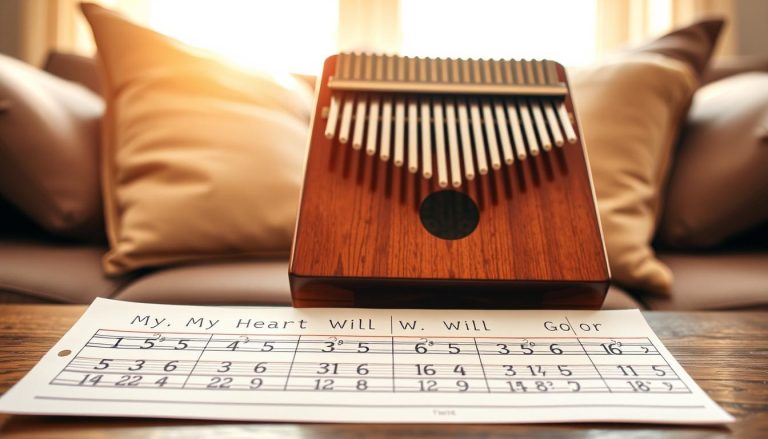
Goal: play this short, familiar melody on a 17-tine kalimba without reading music, one step at a time.
Who this is for: beginners, parents with children, and musicians returning to practice. You will find tablature, numbered sheet music, a letter-note version, and practical tips.
The method is simple: check the tuning, find the tines, read the notation, and learn the melody in small sections. Start with a version you can play in a few minutes.
Then work on the rhythm and rests for a more polished performance. Allow time for a quick first attempt, followed by short sessions with a metronome.
What you will learn: how to play the tune, read the notation, decide whether the instrument needs tuning, and find printable materials. Short recordings will help you measure your progress.
Why Learn Frère Jacques on the Kalimba as a Beginner?
Choosing a familiar tune helps you learn faster. A short, repetitive melody makes the note sequence easy to remember. You can focus on thumb accuracy instead of trying to recall the tune.
A familiar melody helps you keep time. The nursery rhyme takes less effort to remember. You can steady the rhythm and practice the rests without losing your place.
The 17-tine kalimba is intuitive to play and has a pleasant sound. You can often hear progress within a few minutes, which makes it easier to keep going.
- Repeated phrases make the melody easy to remember and help steady the rhythm.
- A familiar tune leaves more attention for clean attacks and even timing.
- A simple musical instrument brings immediate enjoyment and noticeable progress in a few minutes.
Here is a simple plan:
- Session 1: find the tines and play one phrase.
- Session 2: connect the phrases.
- Session 3: establish a steady tempo and play more accurately.
| Goal | Target time | Expected result |
|---|---|---|
| Find the notes and play the first phrase | 10 minutes | Find the central tines and play the first phrase |
| Connect the phrases | 15 minutes | Move smoothly between sections |
| Establish the tempo | 10 minutes | Play an even, more polished version |
If you want a clear starting point, see this sheet music for a 17-tine kalimba. Do not worry about mistakes: aim for a smooth run-through first, then improve your timing and accuracy.
The 17-Tine Kalimba, or Thumb Piano: What to Know Before Playing
Before putting your thumbs on the instrument, you need only a few basic reference points. This model has a wooden body and 17 metal strips. Each strip, or tine, vibrates to produce a distinct note.
Understanding the Tines and Note Layout
The layout is much like a thumb piano: the central tines are the easiest notes to reach.
Find the central tine, then look at the symmetrical layout. Many models have engraved numbers or letters to help you find your way.
Holding the Instrument and Using Both Thumbs
Hold the instrument in your palms or place it on a stable surface. Relaxed shoulders and loose wrists help prevent tension.
Alternating your thumbs makes phrases flow more easily and reduces fatigue.
Why the Sound Is Forgiving for Beginners
The kalimba’s warm resonance can soften small inaccuracies. Its generous sound makes learning rewarding.
Even so, resonance does not replace rhythm practice: pitch accuracy and timing improve as you play.
- Tip: begin near the center, then gradually reach farther outward.
- Check the engravings to connect the notes with what you hear.
Tune Your Kalimba Before Following Sheet Music
A tuned instrument makes learning easier and prevents you from memorizing the wrong pitches. Tines can shift during transport or after a knock.
Why tuning matters: an out-of-tune instrument teaches your ears the wrong notes. That is frustrating and slows progress.
Step-by-Step Tuning With a Tuner App
Choose an app such as gStrings, Smart Kalimba, or Free Universal Tuner. In a quiet place, pluck one tine, read the displayed note, adjust its tuning, and move to the next.
Small Adjustments: Push or Pull Gently
Push slightly to raise the note or pull to lower it. Make very small adjustments. A small tuning hammer can help if you tap gently.
A Quick Routine Before Each Session
Checking two or three key notes near the center saves time. Give them a quick check before you start playing.
Common Mistakes and Simple Fixes
- Using too much force → start again with smaller adjustments.
- Ignoring beats between nearby notes → listen and fine-tune them.
- Failing to check after an adjustment → check the note several times.
| Step | Action | Time |
|---|---|---|
| Preparation | Open the app and find a quiet place | 1 minute |
| Center, then outer tines | Tune one tine at a time | 3 to 5 minutes |
| Final check | Check the notes quickly | 30 seconds |
Read Kalimba Sheet Music and Tablature Without Reading Standard Notation
Once you understand numbered notation, you can start playing straight away. Each number corresponds to a tine: find the number, connect it to its note, and play.
Numbered Notation: Matching Numbers, Tines, and Notes
Numbered sheet music keeps things simple. Each number corresponds to a tine. It is ideal if you cannot read standard notation.
Quick method: find three numbers near the center, play them repeatedly, then add the next notes.
Vertical Tablature: Following the Reading Direction
Read vertical tablature from top to bottom. It shows where to play and where to rest more clearly than a simple note sequence.
Look ahead to the next note and prepare your thumbs to avoid hesitation.
Rhythm and Rests
Count aloud and use a slow metronome. Play very slowly at first, settle into a steady tempo, then increase it.
A Memory Tip
Put numbered stickers on the tines, practice, then gradually remove them. This develops both listening and visual memory.
- Key difference: the sheet music focuses on pitch, while the tablature shows note lengths and rests.
- Alternate thumbs whenever you can for smoother playing.
| Goal | Method | Time |
|---|---|---|
| Read numbered notes | Find the numbers → play them repeatedly | 5 to 10 minutes |
| Read vertical tablature | Read downward and look ahead | 10 minutes |
| Memorize the notes | Use stickers, then gradually remove them | Gradually |
If you want ready-to-use material, see this practical sheet music collection for guidance.
Frère Jacques on the Kalimba: Easy Tablature for Beginners
First, identify the song’s four short phrases.
What you will play: the song has four main phrases that repeat. Learn each phrase separately so you can remember the melody without getting sidetracked.
Structure and Repetition
Play the first phrase slowly to find its tines. Play it a second time while focusing on the rhythm.
Repetition first helps you locate the notes, then steadies your attacks and rests.
Suggested Tempo
Start deliberately slowly. A calm pace prevents reading mistakes and helps you play accurately.
A realistic goal is to play the whole tune smoothly after a few minutes, then develop steady timing with a metronome over a few short sessions.
- 4 phrases = learn in sections.
- First time: find the notes.
- Second time: work on tempo and consistency.
- Goal: even attacks and clear resonance between phrases.
| Step | Action | Estimated time |
|---|---|---|
| Find the notes | Play the first phrase slowly | 2 to 5 minutes |
| Repeat | Strengthen the rhythm and rests | 5 to 10 minutes |
| Play smoothly | Connect all four phrases at your chosen tempo | A few minutes |
The following sections offer a video, numbered sheet music, letter notes, and detailed tablature to support your progress.
Learn With a Video: Play the Tines in the Right Order
A clearly framed video shows exactly which tines to play and in what order. It helps you learn the movement, rhythm, and thumb positions.
Why Video Helps When You Cannot Yet Read Sheet Music
Watching before reading lets you copy the movement and avoid early reading mistakes. Children and beginners often remember more easily by imitating.
Listen to the Original Melody First to Hear the Phrasing
Listen, then imitate: listen to the original once, hum a phrase, then play the sequence on your instrument.
- Copy the movement: check the order of the tines and the direction of your thumbs.
- Slow the video down if possible, then play without it to test your memory.
- If a passage is difficult, isolate two or three notes and repeat them until the movement feels automatic.
- Practice phrasing: pause between phrases and emphasize the words to make the tune more musical.
| Step | Action | Time |
|---|---|---|
| Listen | Listen to the original melody | 30 to 60 seconds |
| Imitate | Copy the video’s movements slowly | 2 to 5 minutes |
| Build fluency | Repeat two or three notes, then add them to the phrase | 5 to 10 minutes |
Once you know the order of the tines, reading sheet music becomes easier. The next step will feel quicker and less daunting.
Tip: connect what you hear with the movement and the words. This helps you remember the tune of Frère Jacques and share it with family or other music lovers around the world.
Numbered Sheet Music for Frère Jacques on a 17-Tine Kalimba
When you are starting out, a sequence of numbers makes the notes easier to find. Numbered sheet music gets straight to the point: it shows which tine to play without crowding the page.
When to Choose Numbered Sheet Music Instead of Tablature
Choose numbered sheet music if you want to learn quickly without reading standard notation. It is easier to scan and helps you memorize the tune.
Choose tablature when you need note lengths and rests for a more expressive performance.
Practical Ways to Connect Phrases Without Hesitating
Notice where each phrase ends and prepare the first note of the next one.
Look ahead to the following note and keep your thumbs near the central tines you use most often.
Playing Tip: Alternate Thumbs and Keep Attacks Even
Alternating thumbs prevents fatigue and improves consistency. Avoid playing too many consecutive notes with one thumb.
Golden rule: play accurately before you play faster. Make each attack steady before increasing the tempo.
| Goal | Tip | Suggested time |
|---|---|---|
| Find notes quickly | Use numbered sheet music and stickers | 2 to 5 minutes |
| Avoid hesitation | Look ahead and keep thumbs near the tines | 5 to 10 minutes |
| Play evenly | Alternate thumbs and use a slow metronome | 10 to 15 minutes |
An Alternative in Letters: When Your Tines Are Marked A, B, and C
If your instrument has letter markings, a simple conversion can prevent confusion. It makes numbered sheet music easier to follow when the tines show letters.
Convert Numbers to Letters Without Common Mix-Ups
Step 1: identify the central note on your kalimba and write down its letter.
Step 2: match each number in the sheet music consistently to the corresponding note letter.
Tip: convert one phrase at a time. It is easier and quicker than converting the whole song at once.
- Common problem: the sheet music uses numbers, but the instrument has letters.
- Possible mix-ups: octave changes, tine order versus note names, and letter notation mixed with the manufacturer’s markings.
- Simple solution: annotate the sheet music in pencil so you do not have to convert it again while playing.
- Practical tip: keep both a numbered version and a letter-note version so you can use different resources.
| Need | Method | Result |
|---|---|---|
| Avoid mistakes | Identify the central note and match the markings | Read more quickly |
| Have more than one reference | Annotate the sheet music once | Fewer repeated conversions |
| Use different resources | Keep numbered and letter-note versions | Make faster progress |
For more examples of notation and conversion, see this dedicated resource. Remember: the aim is to play the melody, not to master music theory immediately.
Frère Jacques Tablature: Understand Note Lengths
Treating rests as carefully as notes gives the piece room to breathe and makes the phrasing clearer.
Tablature provides three useful details: note lengths, rests, and when to play each note. They give structure to even a short melody.
Learning carefully now helps you avoid rhythmic habits that are harder to fix later. Good timing will also help when you move on to denser pieces.
A Suggested Reading Routine
- Read through one line silently.
- Play very slowly and count the beats aloud.
- Check your timing, then increase the tempo in stages.
A Focused Exercise
- Mark the rests by counting the beats aloud.
- Let longer notes ring before playing the next one.
- Work on one challenge at a time: note placement first, then speed.
This practice method prepares you for chord tablature and arpeggios in more complex pieces. For a clear reference, see the sheet music and follow the routine step by step.
Download and Print Sheet Music and Tablature PDFs in France
Clear, print-ready sheet music makes practice easier. Instruments du Monde offers 41 free PDF articles organized by difficulty and theme, with an average rating of 4.6/5. You can view and download these resources from France.
- Open the PDF and check the page layout.
- Select A4 paper and set the scale to 100% to preserve the markings.
- Check that the numbers, letters, and rests are easy to read.
Good Practices for A4 Printing
Print on A4 at 100% to keep the markings aligned. If the document has narrow margins, choose “actual size” or “no scaling.” Print a test page before making several copies.
Organize Sheet Music and Tablature in a Binder
Sort your pages by level and theme, such as nursery rhymes, films, pop, and video games. Use dividers, then write the date and version on each page in pencil.
Recording thumb positions, sections to repeat, and target tempos makes progress easier to track. Keep a printed “short version” for quick sessions.
Share the PDF to Play With Your Family
Print several copies so you can play together and compare versions by tempo, dynamics, and resonance. Sharing keeps you motivated and encourages useful suggestions.
| Action | Tip | Time |
|---|---|---|
| Download | Choose free resources organized by difficulty | Immediate |
| Use A4, 100% scale, and a test page | 1 to 3 minutes | |
| File | Organize a binder by level and theme | 5 to 10 minutes |
Step-by-Step Tutorial: Play Frère Jacques With Ease
Breaking the tune into very short sections makes learning quick and manageable. Follow these four steps to turn a few measures into a piece you can play accurately.
Break the Tune Into Short Sections and Repeat Them
Learn the first phrase, then the second, before joining them together. Work in sections of four to eight measures.
Repetition rule: play a section slowly and correctly five times before increasing the speed slightly.
Work on Pitch Accuracy
Check the central tines first because you use them most. They have a strong effect on how the whole tune sounds.
Then check the outer tines, which can shift out of tune during transport.
Build Consistency
Use a slow metronome and count aloud. Resist speeding up through passages you already know.
Add Musical Expression
Play more gently at the start of each phrase and let the notes ring. Avoid gripping the instrument so tightly that you dampen its vibration.
Assess Yourself Quickly
Record 20 to 30 seconds of your playing, using RecForge Lite, for example. Listen back and choose just one thing to improve in the next session.
Suggested plan: work on four to eight measures, repeat them, begin slowly with a metronome, count aloud, record yourself, and correct one or two things. You can use this method for future pieces too.
| Goal | Action | Time |
|---|---|---|
| Learn in sections | First phrase → second phrase → play them together | 5 to 10 minutes |
| Repeat | Play correctly five times at a slow pace | 10 to 15 minutes |
| Assess | Make a 20-to-30-second recording and identify one improvement | 2 to 5 minutes |
For a clear printable reference, download the dedicated sheet music and use this method for a few minutes each day.
After Frère Jacques: Routines and Tools for Further Progress
A well-planned 15-minute routine turns occasional effort into noticeable progress. Make regular practice your priority, even when sessions are short. Three short sessions a week can be more useful than one long, irregular session.
A 15-minute daily practice plan: warm up for three to four minutes, spend eight to ten minutes on a section of four to eight measures, then play freely for one or two minutes to stay motivated. Finish with a short recording to track your progress.
Useful Apps
Use gStrings as a tuner and metronome. Try Simply Kalimba for automatic note recognition. To annotate and record your versions, choose Kalimba Tabs Editor Pro.
Practical Playing Tips
Keep a neutral posture and use a light touch. Take short breaks to avoid fatigue. Wipe the tines after each session and place the instrument on a non-slip mat for stability.
Build a Small, Motivating Repertoire
Choose short songs from nursery rhymes, films, pop music, or video games. Start with simple versions and gradually move to more complex ones. Sort your pieces by difficulty (beginner → intermediate → advanced) and keep a guide to your progress.
To find ready-to-use printable materials, explore 17-tine kalimba sheet music PDFs and collect lawful resources that will support your long-term practice.
Conclusion
To sum up, focus on three things: tune the instrument, read numbered sheet music or simple tablature, and practice slowly and regularly.
Why this method works: the repeated melody builds rhythm, thumb coordination, and confidence on this wooden 17-tine thumb piano.
Keep your daily routine short. Increase the tempo only when you can play accurately. Save your sheet music and build a small library of printed resources.
Start with short versions, then develop them by working on note lengths, rests, and dynamics. Add one or two other familiar tunes to stay motivated.
A cultural note: the song appeared in Capelle’s collection as early as 1811 and has sometimes been linked to Jean-Philippe Rameau, though its authorship remains uncertain.
To expand your repertoire, discover essential French songs in this selection.