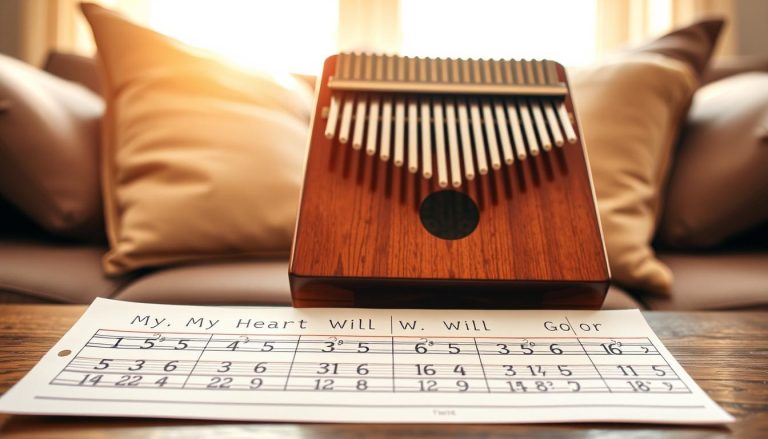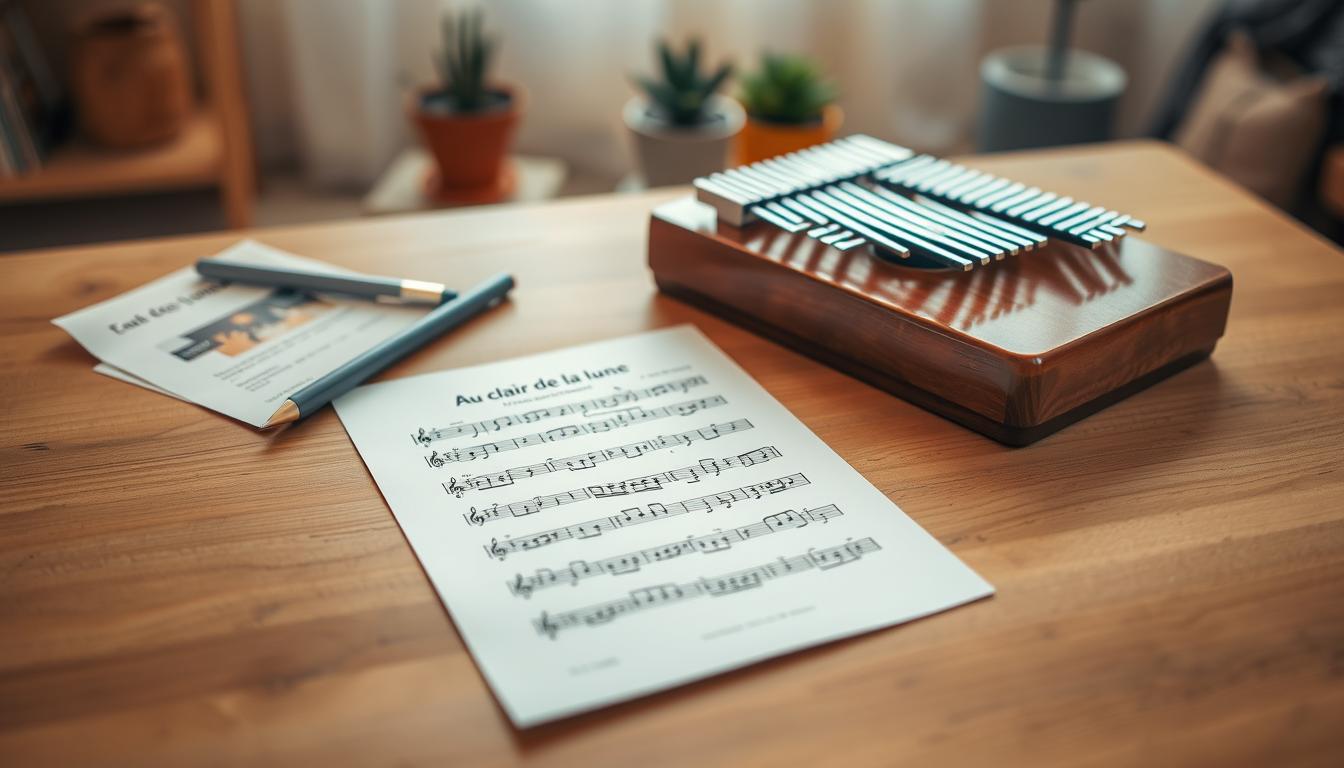
Goal: learn a simple melody on a small musical instrument without reading standard notation. This guide is for beginners who want to start playing quickly and enjoy themselves.
Here you will find numbered notation, letter notation and tablature. The method takes you through each step: tuning, simplified reading, then gradually playing the piece.
Don’t worry: numbered notation and markers on the kalimba keys are enough. We also offer tips for improving your sound and avoiding common mistakes.
The song is short and familiar, ideal for playing to children or practising for a few minutes each day. Printable A4 PDF resources are available in France.
The plan: tuning → reading → sheet music and tablature → practice → improvement. Follow it to make quick progress.
Why learn “Au clair de la lune” on the kalimba as a beginner?
Starting with a familiar tune makes a difference. This nursery rhyme is easy to learn because it repeats and uses few notes. You can recognise it by ear from the first few bars, which helps keep you motivated.
Learning benefit: this short piece lets you practise timing and accuracy without getting lost in a long sequence. Beginners make quick progress by repeating short musical phrases.
The main benefit is enjoyment. Getting a satisfying result quickly encourages regular practice. Playing for children or family makes learning fun.
- When to play: workshops, family time or relaxing breaks.
- A short piece means less to remember and more useful repetition.
- Progress: mastering this classic prepares you for other simple melodies.
“A short, familiar tune builds confidence in the first week.”
Understanding the 17-key kalimba, also called a thumb piano
Practical and easy to see, this thumb piano invites you to play without demanding technique.
Construction and note layout
The standard model has 17 metal keys mounted on a wooden body. The notes follow a pattern: the lowest sounds are in the centre, and the notes get higher towards the outside.
The body acts as a resonator: it amplifies the sound and warms the tone. The layout makes it easier to find notes by touch and sight.
Why it feels intuitive to play
You mainly play with both thumbs. The movements feel natural and symmetrical.
Visual markers on the keys help you remember where the notes are. You hear the result immediately, so you can check each movement.
A gentle sound and practical tips
The tone is warm and forgiving: it softens small inaccuracies and encourages relaxed practice.
- Choose a stable, well-tuned instrument.
- Look for a surface that feels comfortable to hold.
- Its light weight makes it easy to carry for short practice sessions.
The natural resonance brings out the slow, singing melody; check the tuning before you play to avoid wrong notes.
Tune your 17-key kalimba before playing the melody
Before you play, take a few minutes to tune your instrument carefully. Good tuning makes the melody clearer and the notes easier to check.
A quick method using a tuning app
Choose a quiet place and open a tuning app. Pluck each key in turn and read the note shown.
Check the displayed note, then move to the next key. You can adjust the central keys first, then the outer ones, in a few minutes.
Adjusting the keys: push for a higher note, pull for a lower one
Push a key slightly inward to raise its pitch. Gently pull it to lower the pitch.
Make small adjustments and check the note after each movement. Start in the centre and work outward.
Common mistakes and a final check
- Do not force a key: a sudden adjustment can damage it.
- Take care not to knock the neighbouring key out of tune while adjusting one.
- Check the whole instrument again by ear to listen for beating between notes.
“Stable tuning turns a short sequence into a real melody and makes learning more rewarding.”
| Step | Action | What to watch for |
|---|---|---|
| Preparation | Tuning app, quiet place | Avoid background noise |
| Adjustment | Push = higher, pull = lower | Small movements |
| Check | Listen to the whole instrument | Recheck the centre, then the sides |
Recommended routine: check the key notes quickly before each session and tune the whole instrument when needed. Once it is in tune, reading sheet music and tablature becomes easier and more enjoyable.
For ready-to-use resources and sheet music, see this practical guide to tuning and sheet music.
Learn to read kalimba sheet music and tablature without knowing standard notation
This accessible approach uses three complementary notation systems that are easy to learn. This guide shows you how to read a numbered sequence, convert it to letters and use tablature to manage the rhythm.
Numbered notation: turning numbers into notes
Each number corresponds to a particular key to pluck. By following the sequence, you can play the melody without reading standard notation.
Add numbered stickers to find the keys quickly. Start slowly and count aloud or use a metronome.
Converting numbers to letters
The standard correspondence is 1 = C, 2 = D, 3 = E, 4 = F, 5 = G, 6 = A, 7 = B. This conversion helps if you already know letter names for notes.
Use the letters to find a note in another learning method or to transpose a piece more easily.
What does tablature add? Note lengths and rests
Tablature adds note lengths, such as quarter and eighth notes, and rests. It shows when to hold a note and when to leave a silence.
The layout may be horizontal or vertical; learn the symbols for note lengths before speeding up.
Ways to find the keys and a short routine
Colour codes, stickers and markers on the central and outer keys make memorisation easier. Remove them gradually so you can play unaided.
Short routine: read → play slowly → check the pitch → repeat until it flows. This prepares you for the next section, which presents numbered notation, letter notation and tablature.
Au clair de la lune on the kalimba: beginner sheet music for 17 keys
Three complementary formats present the same melody to suit your preference: numbers, letters or tablature. Each serves a particular purpose when learning quickly without standard notation.
Numbered version: the easiest place to start
How to use it: find the numbered key, play very slowly and check that the sequence sounds like the song. A simple example: 1‑2‑3‑1 / 3‑4‑5 / 5‑4‑3‑2 / 1‑2‑3‑2‑1.
This version is ideal for children and first attempts.
Letter version: a direct conversion
If you think in note names (C, D, E…), the conversion makes it easier to transpose the tune or move to another instrument.
Tablature version: greater rhythmic precision
Tablature shows note lengths, rests and sustained notes. It helps you work on expression and phrasing.
“Start with the numbers, check the sequence, then move to letters and finally tablature to refine the rhythm.”
Practical advice: do not play too fast. Repeat each short sequence until you know it, then join the sequences together.
| Format | Benefit | When to use it |
|---|---|---|
| Numbers | Very simple and quick to memorise | First attempts, children |
| Letters | Makes transposition easier | If you read notes as C, D, E |
| Tablature | Precise rhythm and note lengths | For expression and phrasing |
Follow this link to download a practical guide with all three forms of notation. The next section offers a step-by-step practice method.
Play “Au clair de la lune” step by step: a beginner’s method
The key to learning is to break the tune into short sequences and repeat them. Begin by isolating four bars, practise them until you can play them, then move to the next section.
Break the melody into short sequences
Divide the piece into groups of four to eight bars. Repeat each group 8 to 12 times before joining it to the others.
Focus on difficult transitions. Repeat only those passages until you can play them correctly.
Work slowly, then speed up in stages
Start at a slow tempo. Use a metronome and increase the tempo in small steps.
Check your accuracy before every increase in speed. This protects the sound quality and helps build muscle memory.
Respect the rests for clear phrasing
Rests shape the melody. Observe them to make the piece instantly recognisable.
Tip: mark the rests in pencil and count aloud as you practise.
Exercises for thumb and hand coordination
Alternate your right and left thumbs on simple sequences. Then play two notes in succession to practise moving between them.
Recommended routine: 10 to 15 minutes a day. In a few days, you should notice progress.
Make a short recording of yourself: it can reveal uneven volume and inaccuracies to correct.
For guidance and practice sheets, see this practice guide.
Find the right tempo: listen to the song before playing it
Before touching the instrument, let the melody suggest its natural tempo. Listening to the piece several times helps you absorb its shape and beat.
Comparing two sources can speed up learning. First, watch a tutorial that shows the keys so you can follow the note changes. Then listen to the original nursery rhyme to hear its character and phrasing.
Practical tips
- Listen first: absorb the rhythm and structure before reading the instructions.
- Watch a tutorial: use the keys shown on screen to identify the notes and fingering.
- Compare versions: listen to the original to understand its intonation and musical character.
- Use clear cues: hum the melody, tap your foot to the beat, then play while keeping that pulse.
Take care: it is common to speed up as you gain confidence. Slow down if the phrasing becomes less smooth.
To keep playing enjoyable: alternate between listening and playing. This guide and these tips make practice pleasant and effective.
Download and print the sheet music and tablature PDF in France
Use a clear, printable document that is easy to memorise from and annotate.
Free access: view, download and print
Instruments du Monde provides a free PDF for viewing, downloading and printing sheet music and tablature.
This central collection contains 41 free articles and displays an average rating of 4.6/5.
Good printing and filing practices
In France, print on A4 paper at 100% scale to preserve the layout.
- Check readability: contrast and font size.
- Test one page before printing the whole document.
- Choose single-sided or double-sided printing according to readability.
- Put the pages in sleeves or file them by level using tabs.
| Action | Recommendation | Why |
|---|---|---|
| Scale | 100% | Preserves the layout and visual markers |
| Quality | High contrast, 80 to 120 gsm paper | Better readability and room for notes |
| Filing | Tabs by level and date | Find the short versions, then move on |
Practical tip: start with the short versions, annotate them in pencil, then file the longer versions. This supports regular practice without relying on a screen.
Playing tips for a better kalimba sound
A clear sound starts with a relaxed posture and controlled movement. These quick tips aim to improve tone and comfort while you practise.
Posture and relaxation
A simple posture to avoid tension
Keep your shoulders relaxed and your wrists loose. Hold the instrument steadily in your hands or place it on a table, whichever feels more comfortable.
Take short breaks every 15 to 20 minutes to avoid tensing up.
A light thumb touch for greater accuracy
A light movement produces clear attacks and reduces fatigue. Apply gentle pressure and let the key ring.
Play the same phrase slowly twice, concentrating on clarity, then play it twice at the normal tempo.
Attack: nail or thumb pad, and expression
Your nail gives a bright, defined sound. The pad of your thumb gives a round, gentle tone.
To add variety to the nursery rhyme, alternate sustained notes with quick muted notes (staccato) in a few passages.
Tip: record yourself once and listen to the balance between the central notes and the outer ones. Adjust your touch according to what you hear.
For an exercise programme and practical sheets, see this learning guide.
Common mistakes when learning “Au clair de la lune”
Understanding why mistakes happen helps you correct them quickly and enjoy playing again.
Playing too fast: this is the most common beginner mistake. Speeding up leads to imprecise attacks and an unsteady rhythm.
The result: the melody becomes less recognisable and confidence falls. A quick fix: slow down with a metronome and practise one bar five times.
Neglecting tuning: an out-of-tune instrument produces wrong notes even when you read correctly.
Correct the tuning in small steps and check it one final time. Allow a minute for a quick tuning check before each session.
Confusing numbers, notes and keys: without markers, reading becomes harder and the same mistakes recur.
Make reading easier with stickers or colours, then remove them gradually. Repeat the same sequence slowly twice before joining it to the others.
- Plan for avoiding mistakes: 1 minute of tuning, 2 minutes of silent reading, 10 minutes of playing short sections.
- Technique: return to a slow tempo, isolate one bar, repeat it five times, then connect it to the next section.
Practical tip: record yourself once a week to spot weak points and track your progress.
For guided exercises and a beginner’s guide, see this tutorial. To expand your repertoire, also explore this selection of essential French songs.
The origins and history of “Au clair de la lune”
Its history combines written sources and oral tradition, making authorship difficult to establish.
Early traces and a final form around the 18th century
A similar motif appears as early as 1576 in a collection by Jehan Chardavoine, who published an anthology of popular poems and tunes.
The resemblance is intriguing, but it does not establish certain authorship.
Debated attributions: Chardavoine and the Lully theory
Some researchers also mention Jean-Baptiste Lully because of similarities to Cadmus et Hermione (1673).
Analyses remain cautious: neither Chardavoine nor Lully provides definitive proof. The familiar form appears more clearly in the 18th century, but its author is unknown.
- Cultural context: the song spread widely through singing and oral tradition.
- Historical record: an early vocal recording made in 1860 by Édouard-Léon Scott confirms its long history.
Playing this melody today keeps a small treasure of popular music alive and connects generations.
The hidden meaning of “Au clair de la lune”: a nursery rhyme with two readings
Some older lyrics have several possible layers of meaning, depending on how the text is read.
Literal reading: the words describe a simple nighttime scene — Lubin or Pierrot knocks on a door, a candle goes out and a neighbour answers. This reading remains plausible and innocent.
Deeper reading: as with other popular songs, older allusions may be present. Some expressions may have figurative meanings linked to past social customs or intimate relationships.
“Battre le briquet”: meaning and interpretations
The expression can mean striking a spark to light a flame. Some researchers also suggest metaphorical meanings.
- Direct reading: a physical action to light a candle.
- Social reading: courting or seducing someone.
- Erotic reading: a possible sexual allusion, depending on context.
Historical caution: the author is unknown and evidence is lacking. Avoid reading too much into the words. The linguistic context of the 18th century makes firm conclusions difficult.
Nursery rhymes can contain cultural and linguistic layers whose meaning cannot be settled definitively.
| Aspect | Reading | Confidence |
|---|---|---|
| Text | Simple nighttime scene | High |
| Expression “battre le briquet” | Spark / courtship / allusion | Moderate |
| Modern interpretation | Varies among researchers | Low (hypothetical) |
Whatever reading you prefer, the melody retains its educational value. It provides a reliable way to practise rhythm, memory and the voice in early music exercises.
Conclusion
In short: get to know the instrument, tune it, learn to read the notes, then choose a format — numbers, letters or tablature — and practise step by step.
Beginner priority: play slowly, respect the rests and increase the tempo in stages. Practise regularly to make the movements familiar.
Try this now: play a short numbered sequence, check it, then find the same phrase in tablature to work on the rhythm.
A simple routine: each day, spend 10 minutes with a metronome; each week, make short recordings to track your progress. Then try other easy songs and explore new melodies.
Goal: enjoy playing, produce a clear sound and build a solid foundation for other pieces and sheet music on thumb pianos.