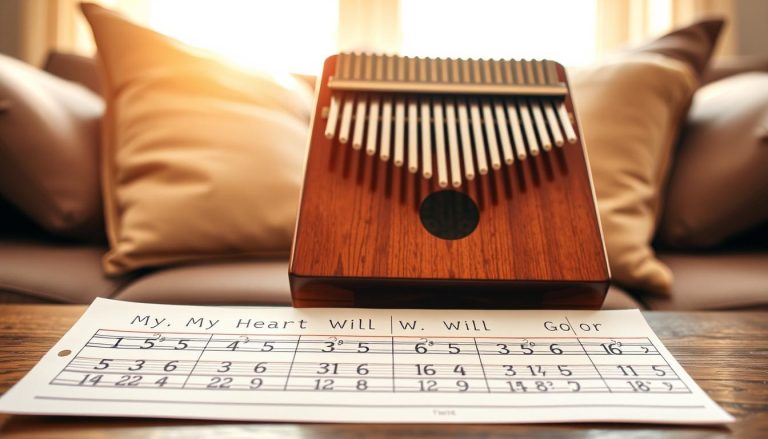
Goal: learn to play this classic on a thumb piano using a gradual method that requires no knowledge of music theory.
This guide covers preparing and tuning the instrument, reading the notation, and playing short and complete versions. You will also find three formats—numbers, letters, and tablature—so you can choose the method that suits you.
Released by Leonard Cohen in 1984 and popularized by Jeff Buckley in 1994, the song has been covered more than 200 times. The resources include numbered sheet music, a letter-notation version, tablature, and a downloadable PDF for playing offline.
Practice plan: start with a short version, establish a steady rhythm, then add chords and ornaments for a more polished sound. With 15 minutes of daily practice in France, you could play a version within a few weeks if your instrument is properly tuned.
For the resources and complete score, follow this link to a dedicated page: sheet music and tablature.
Why Play Hallelujah on a 17-Key Kalimba
For beginners, this tune is ideal practice material: it combines an easy-to-remember melody with rich dynamics. A 17-note instrument covers the entire theme, and playing with the thumbs feels natural.
A familiar melody that is ideal for beginners
- A well-known, memorable tune helps you learn faster and stay motivated.
- Its gentle tone brings out slow melodies and helps you work on musical expression.
- Playing with your thumbs is intuitive and quick to learn, without complex theory.
What You Will Be Able to Do by the End of This Guide
You will be able to tune your instrument, read numbered or letter notation, and follow simple tablature. You will keep a steady tempo and learn to add simple chords for richer resonance.
“Start with a short version: progress step by step and practice regularly.”
A measurable goal: play the main theme cleanly within a week, then work toward a fuller version so you can hear your progress at each session.
Prepare Your Kalimba Before You Begin
A comfortable grip is the foundation of smooth, relaxed playing. Before tackling the melody, adopt a relaxed posture: keep your shoulders loose and your back straight, without tensing up. This protects your joints and improves accuracy.
Posture, Grip, and Thumb Placement
Hold the instrument with open hands, without squeezing its body, so it can resonate freely. Steady it with your palms and fingers without blocking the openings.
Keep your thumbs slightly curved in playing position. Gently brush and release the tines. Alternate your left and right thumbs to move cleanly between notes.
Note Stickers: Useful at First
Numbered stickers make visual learning easier. They reduce the time you spend looking for keys and help you read your first numbered scores.
- Start by placing markers on the central notes.
- Remove them gradually, working from the center outward, to develop muscle memory.
Tip for avoiding fatigue: take short breaks and check the length of your nails so you can keep your attack clear and consistent.
“Good posture cannot make up for poor tuning: the next step is to tune the instrument accurately.”
For the complete guide and resources, see the dedicated page.
Tuning a 17-Key Kalimba: Avoid Wrong Notes
Accurate tuning is essential for avoiding wrong notes and preserving the beauty of the melody.
Why tune the instrument? Even with a good score, an out-of-tune instrument sounds unpleasant, especially when playing a slow melody.
Tuning with an App: Step by Step
- Find a quiet place.
- Open a tuner on your phone and select the target note.
- Pluck the tine, read the display, then adjust the tuning in small increments.
Small Adjustments: Higher or Lower
Pushing a tine inward raises its pitch. Pulling it outward lowers the pitch.
Never force it: make small adjustments and pluck the tine again after every movement.
Common Mistakes and Quick Fixes
- Using too much force: reverse the adjustment in small steps.
- Tuning without checking again: compare the note with a neighboring tine.
- Ignoring beats between notes: listen for them and adjust the tuning gradually.
A Quick Check Before Every Session
Check a few key notes once, particularly the central and dominant notes. It takes little time and immediately improves the sound.
| Step | Action | Expected result |
|---|---|---|
| 1 – Preparation | Quiet surroundings, tuner ready | A clear note reading |
| 2 – Central tines | Tune the central tines first | A stable reference for the rest |
| 3 – Outer tines | Work symmetrically toward the edges | Consistent tuning |
| 4 – Check | Check again and compare by ear | No audible beating |
“A quick, regular check saves time and prevents unpleasant surprises while you play.”
Read Kalimba Sheet Music and Tablature Without Music Theory
Turning numbers into music becomes easy once you know how the notes correspond to the keys.
Numbered Notation: Matching Numbers to Tines
Each number corresponds to a specific tine. On an instrument tuned to C major, the usual pattern is 1 = C, 2 = D, 3 = E, and so on through 7 = B.
Tip: add note stickers at first to speed up learning.
Letter Notation: Another Practical Option
Letter notation—C, D, E, and so on—is useful when you consult international resources.
It identifies pitches directly without changing how you read the numbers.
Reading Tablature: Direction and Visual Cues
Tablature shows where the tines are and which way to read. Lines and numbers indicate the fingers and the order of notes.
Rhythm and Rests: Count Slowly
Count slowly with a metronome. Work phrase by phrase, covering 4 to 8 bars at a time.
Observe the rests: they shape the melody and steady the rhythm.
| Format | Reference | Use | Tip |
|---|---|---|---|
| Numbers | 1 to 7 | Quick reading | Use stickers at first |
| Letters | C, D, E… | International resources | Ideal if you think in note names |
| Tablature | Visual layout of the tines | Includes chords and arpeggios | Read in the indicated direction |
“Start slowly, phrase by phrase, then work on tempo and expression.”
To download easy scores, see this dedicated resource: easy sheet music in PDF format.
Listen to Hallelujah to Find the Rhythm
Listening closely to two key recordings shows you how to shape the melody and rhythm.
Compare the Original with the Best-Known Cover
Start with Leonard Cohen’s 1984 recording for its understated storytelling. Then listen to Jeff Buckley’s 1994 version for its emotional intensity.
Notice the Tempo, Breathing, and Musical Intent
What should you listen for? Focus on the overall rhythm, the slight slowing at the ends of phrases, and the pauses between motifs.
Notice how the sound is allowed to resonate: that is often what makes a melody expressive on a simple instrument.
- Guided listening: Cohen for the storytelling, Buckley for the rising intensity.
- Sing each phrase in your head to help place the notes.
- Choose a comfortable tempo, steady it with a metronome, then make the performance your own.
| Element | What to listen for | How to apply it |
|---|---|---|
| Tempo | Overall speed | Choose a practice tempo with a metronome |
| Rests | Breaths and pauses | Observe the rests to clarify the melody |
| Expression | Restraint or intensity | Adjust your attack and dynamics |
“After listening, begin with a short version, then work toward the complete one.”
Hallelujah on the Kalimba: 17-Key Sheet Music and Performance Tips
A gradual approach makes the theme easier to learn and master.
Start with a short version: begin with the main melody. This helps you master the transitions and quickly achieve a satisfying result.
The quality of the sound depends on two things: good tuning and a precise attack. A suitable instrument improves resonance and sound projection.
Goal: A Clear Melody and Clean Resonance
Aim for a distinct melody, notes free from unwanted noise, and controlled resonance that sounds neither muffled nor muddy.
Clean playing means precise attacks, no accidental strikes, and balanced volume between the central and outer tines.
“Play slowly, correct any hesitation, then increase the speed once your playing is steady.”
Practice Method and Progression
- Practice slowly with a metronome, phrase by phrase.
- Correct each hesitation before speeding up.
- Add chords or arpeggios from the tablature to enrich the complete version.
| Stage | Goal | Suggested time |
|---|---|---|
| Short version | Master the main melody | 3 to 7 short sessions |
| Consistency | Clear attacks and a reliable rhythm | 2 to 3 weeks, depending on practice |
| Complete version | Add chords and ornaments | Progress gradually once your playing is steady |
The aim: with a simple method and a brief routine, you can progress quickly from a shortened theme to the complete version.
Numbered Hallelujah Sheet Music for a 17-Key Kalimba
Numbered notation turns a sequence of numbers into simple hand movements. It is an excellent starting point if you cannot read standard notation and want to play a familiar song quickly.
How to Position Your Thumbs to Play Without Hesitating
Always look two numbers ahead. Scan the next notes, then prepare the thumb that will play. Reading ahead keeps you from searching for a tine at the last moment.
- Position: keep your thumbs slightly above the central area for direct access to the notes.
- Movement: make short movements, alternate your left and right thumbs naturally, and reposition them subtly between phrases.
- Practice: work slowly, phrase by phrase, then raise the tempo when your playing is clean.
Suggested sequence: phrase A, then phrase B, then the chorus. Repeat each short section until it is steady.
| Short section | Goal | Suggested practice |
|---|---|---|
| Phrase A | Steady the main melody | 3 to 5 slow repetitions |
| Phrase B | Work on note sequences and transitions | 4 to 6 focused repetitions |
| Chorus | Sustain notes and manage resonance | Repeat at a slower tempo |
Sound tip: listen for notes that ring too long. Use a lighter attack to keep the melody clear. Slow, accurate practice is better than speeding up and making mistakes.
“Reading two numbers ahead makes all the difference: you gain anticipation, fluency, and confidence.”
Hallelujah in Letter Notation: Same Melody, Different Symbols
Letter notation provides a simple link between English-language resources and your playing. This version replaces numbers with C, D, E, and so on to name the notes.
Who is this format for? Piano and guitar players, people whose tuners display letters, and anyone consulting international resources.
The melody stays the same; only the notation changes. This makes it a practical way to compare scores without relearning the tune.
The mental conversion is simple: match C to do, D to re, and E to mi, then check the corresponding markings on your instrument. This helps you learn and remember the notes.
Technical tip: choose one notation to begin with. Avoid mixing numbers and letters during your first sessions. Later, use the other format to check your playing.
Suggested exercise: play the same phrase while reading the letters, then the numbers. Repeat slowly to fix the melody in your memory. After that, tablature will help you add chords and manage resonance for a more polished result.
“Alternating between letter and numbered notation strengthens memory and fluency.”
Hallelujah Kalimba Tablature: An Arrangement for a Polished Sound
Tablature turns a sequence of notes into a visual guide for your fingers.
Benefit: good tablature shows your fingers where to go on the tines, makes transitions easier to follow, and gives you a clear view of the melody.
What Does a Polished Sound Mean?
A polished performance combines melody and harmony. Simple chords support the main melody.
You can hear the quality in the balance between melody and accompaniment and in the control of resonance.
A Gradual Approach and Routine
- Play the melody alone until it is steady.
- Add chords on selected strong beats.
- Work on resonance: let notes ring or mute them as the passage requires.
Practical technique: use a lighter attack on sustained notes, avoid letting too many vibrations overlap, and add short pauses to clarify the melody.
Repeat changes of register, record yourself, then adjust your playing if the chords obscure the melody. Printed tablature makes it easier to progress and practice without a screen.
Download and Print Hallelujah Kalimba Sheet Music as a PDF
Downloading a PDF lets you play offline and annotate your pages in pencil. The document brings together useful scores and tablature for practice. It provides a stable reference when a screen is distracting.
Playing Offline: Organize Your Scores and Tablature
Make a binder with dividers for each level and style. Put the short version first, followed by the complete one. Write the tempo and difficult passages on the page to save time during practice. PDF files are easy to annotate, copy, and keep.
A4 Printing Tips: Readability and Scaling
Print on A4 paper at 100% scale. Avoid the “fit to page” option, which distorts the markings. Choose high contrast and wide margins for notes. Check the size of the numbers, letters, and tablature markings before printing the whole document.
“Choose clear sites that explain the terms of use for their files and provide readable PDFs.”
For free resources and print-ready files, see this practical resource: download guide. Instruments du Monde also offers documents you can view and print for practice.
Performance Tips for an Expressive Version
To bring a simple melody to life, first focus on the intent of each phrase. Play more softly where the melody breathes, and bring out key notes slightly to create an emotional direction.
Nuance and dynamics: vary your attack and volume. A softer attack on passing notes gives the melody room to breathe. Work on resonance by letting long notes ring without covering the main motif.
Rests and sustained notes: leave short pauses between groups of notes. Do not speed up when you feel nervous: a well-controlled sustained note strengthens the dramatic effect.
Metronome and Rubato
First steady the rhythm with a metronome. Once you can play consistently, introduce slight changes in tempo to make the phrasing your own.
The Three Rs: Repeat, Reduce Speed, Refine
- Repeat a short phrase until you can play it comfortably.
- Reduce the speed until you can play without mistakes.
- Refine your attack, volume, and rests.
| Aspect | Aim | Practical tip |
|---|---|---|
| Clarity | Make the melody audible | Keep the melody ahead of the chords |
| Consistency | Steady the rhythm | Use a metronome, then add rubato |
| Rests | Create emotion | Give the phrases room to breathe |
“Listen to a reference performance once a week, then play the piece again to adjust your intent and phrasing.”
Make Quick Progress with a Short Practice Plan
Use a brief routine to turn fifteen minutes of practice into real progress.
A Fifteen-Minute Daily Routine
2 min: quickly check the tuning and prepare the instrument.
3 min: warm up with slow scales and alternating thumbs.
8 min: focus on 4 to 8 bars, phrase by phrase.
2 min: play freely to absorb what you have practiced.
Always work in short sections. Aim to play one section without hesitation before extending it. Start slowly, then gradually increase the tempo by 2 to 5 beats per minute once you have mastered the phrase.
Record Yourself to Check Tuning, Rhythm, and Consistency
Recording is a powerful learning tool. It reveals uneven timing, overly strong attacks, and tuning problems that can be hard to notice while playing.
“Listening to a recording of your playing helps you decide what to work on next.”
Use these simple criteria to assess your playing: accurate tuning and attacks, a steady rhythm, consistent volume, and a clear melody.
| Activity | Time | Goal | Indicator |
|---|---|---|---|
| Tuning check | 2 min | Check the tuning | No audible beating |
| Focused practice | 8 min | Steady 4 to 8 bars | No hesitation at a slow tempo |
| Tempo increase | 1 to 2 sessions | Speed up gradually | 2 to 5 more beats per minute, without mistakes |
| Alternation | Every other day | Avoid overloading your practice | Day A: melody; day B: chords |
Alternate your sessions to keep progressing without tiring yourself out. This approach respects your time and makes daily practice more effective.
Reliable Resources and Repertoire Ideas for a 17-Key Kalimba
Finding reliable resources speeds up learning and saves time.
Where to Find Free, Legal Sheet Music and Tablature
Choose sites that explain the terms of lawful access, let you sort resources by level, and offer a print option. Clear, downloadable documents reduce mistakes during practice.
Examples and Selection Criteria
What to check: file readability, stated usage rights, difficulty ratings, and a printable PDF option.
Instruments du Monde offers 41 free articles that can be viewed and printed, with an average rating of 4.6/5. It is a practical library for beginners.
Repertoire Ideas to Stay Motivated
Vary your pieces: simple nursery rhymes, film themes, pop songs, and video game music. This keeps your interest up between sessions devoted to your main piece.
Suggested approach: choose one easy warm-up piece, one favorite piece for motivation, and one challenging piece for technical progress.
Useful Tools
- Tuner: gStrings, a tuner, and a metronome.
- Playing feedback and progress tracking: Simply Kalimba.
- Editing: Kalimba Tabs Editor Pro for creating or simplifying your tablature.
| Criterion | Benefit | Example |
|---|---|---|
| Legal access | Use with confidence | Instruments du Monde |
| Sorting by level | Focused progression | Beginner or intermediate filter |
| Printable format | Offline practice | Downloadable PDF |
“A good tuner, a readable resource, and a short routine are more useful than a pile of files with no plan.”
Conclusion
A convincing performance begins with careful preparation and stable tuning. Get comfortable holding the instrument, check its tuning before each session, then choose the notation that suits you: numbers or letters.
Move on to tablature to add chords and refine the resonance. Practice phrase by phrase, anticipate where your fingers need to go, and keep your routine short so you continue to improve.
Keep your scores and tablature as PDFs; annotate fingerings, tempos, and difficult passages. Build a small repertoire of familiar songs to stay motivated and vary your practice.
Final goal: achieve a clear, steady, moving performance in which technique supports expression on this instrument. With careful tuning and a simple plan, the quality of your melodies will improve quickly.