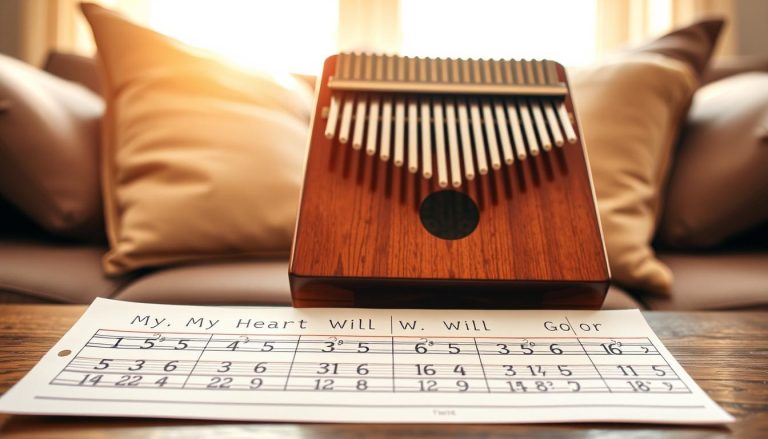
Goal: learn to play this iconic melody on a 17-key instrument using a clear, step-by-step method.
This tutorial is for fans and motivated beginners, as well as intermediate players who want an accessible yet faithful version. You will find numbered tabs, a letter-note version, octave markers and practical tips.
Key tip: if it does not sound right, check the tuning first: a well-tuned instrument makes all the difference. A simple tuner and a step-by-step method will save you a lot of trouble.
Here is how you will progress: 1) prepare the instrument and understand the notation, 2) play the main sequence, 3) improve your accuracy with fingering and rhythm, 4) add expression by learning the musical context.
Musically, this theme suits the kalimba’s crystalline, music-box-like sound. By the end, you will be able to play a recognizable version and have a solid foundation for increasing the tempo.
Additional resources and downloadable sheet music are available through this link.
Before playing the kalimba: tuning, reading tabs and essential markers
A properly tuned instrument and a good grasp of the notation will help you sound clear from the first notes.
Tuning a 17-key instrument
Why tuning is essential: even one tine that is too flat or too sharp can make the melody sound wrong. Check the tuning before each practice session.
- For 17-key instruments: most arrangements start with a C tuning.
- Checklist: check the key (often C), test the reference tines 1/C, 5/G and 6/A, then retune as needed.
Understanding the notation: numbers, letters and solfège
You will come across three formats: numbered tabs (1–7), letter notes (A B C…) and solfège (Do Re Mi). Choose whichever makes the most sense to you.
| Number | Letter | Solfège |
|---|---|---|
| 1 | C | Do |
| 2 | D | Re |
| 3 | E | Mi |
| 4 | F | Fa |
| 5 | G | Sol |
| 6 | A | La |
| 7 | B | Ti |
Octaves and symbols
A dot above a note indicates a higher octave. These notes give the theme an airy, magical quality.
Notes in parentheses are played together to form a chord, or as a glissando, depending on the arrangement. Watch out for common mistakes: confusing 1 with 1° (the higher octave) or failing to play the notes of a chord together.
For more resources and tablature, see these kalimba resources.
Harry Potter kalimba sheet music: play Hedwig’s Theme easily
Listening to the original, then to a version adapted for the kalimba, helps you understand the rhythm and phrasing. Listen closely: notice the accents, pauses and gentle touch of the short notes.
“Careful listening turns a string of numbers into a lively performance.”
Method: listen to the original first to understand its character, then watch a video or listen to a recording played on the kalimba to work on articulation.

Numbered tabs (main sequence)
Here is the opening sequence in numbered tabs:
3 (61) 1° 7 (61) 3° (2°4)
(75) (61) 1° 7 (52) (61) (31) 1 3 …
Converting to letters and recognizing patterns
Numbers → letters: 1=C, 2=D, 3=E, 4=F, 5=G, 6=A, 7=B. For example: 3 (61) → E (A C).
Fingering and practice plan
- Alternate your thumbs for fast passages.
- Practice the notes in parentheses slowly until you can play them together precisely.
- Simple plan: 5 minutes with a slow metronome, 5 minutes on the patterns, and 5 minutes joining the passages.
Resources: a downloadable tablature PDF and a collection of tabs for practice. An intermediate-level play-along video can help you check the rhythm and note attack.
Understand the piece to play it better: Harry Potter, Hedwig and John Williams
Understanding the story behind the piece turns a melody into a musical narrative. J. K. Rowling’s novel series (1997–2007) and its eight-film adaptation created a world in which the music signals an entry into magic.
Why the melody became iconic: it returns throughout the films as a leitmotif. From its first notes, audiences instantly recognize the series and feel a sense of wonder and mystery.
John Williams composed the theme for the first film. His writing favors memorable motifs that can readily be adapted for the piano or other instruments. Williams also wrote themes for Star Wars, Indiana Jones and Jurassic Park.
Other composers worked on the later films (Patrick Doyle, Nicholas Hooper and Alexandre Desplat). But the original version is often the reference for arrangements.
The theme’s name refers to Hedwig, Harry’s owl. It can evoke the character or symbolize the link between worlds.
To play it, use a light, almost mechanical touch, and treat the rising phrases like sudden appearances. For an adapted arrangement and tablature, see this 17-key arrangement.
Conclusion
Remember that progress comes one note at a time.
Summary: start with accurate tuning, learn the notation, then play the sequence using numbered tabs. Convert it to letters and practice the fingering with a short, regular routine.
For a clear sound, begin slowly, aim for accuracy, respect the octaves and take care with the chords in parentheses.
Use the practical resources (the PDF and demonstration video): print the sheet music, mark difficult passages and follow the example for the rhythm. See these practice resources.
Next, gradually increase the tempo and add dynamics (softer or more emphatic playing). Once you have mastered the theme, apply the same method to other film music.