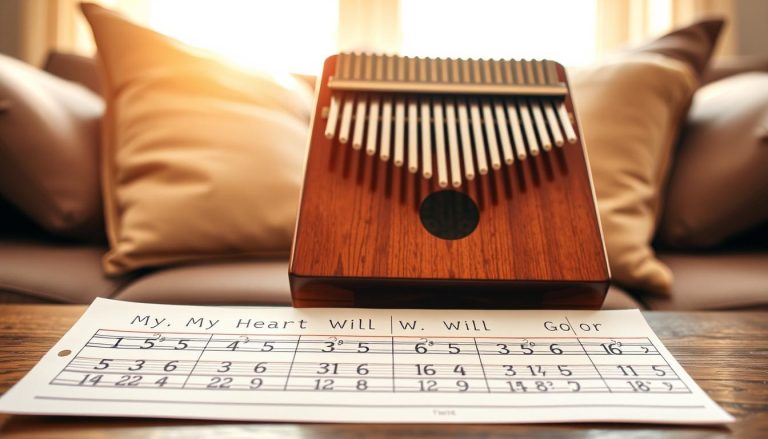
Want to play movie tunes quickly? This practical guide helps you get started in France with a clear goal: learn quickly without getting discouraged.
The focus is the 17-tine kalimba, an ideal instrument for simple melodies. You will find beginner-friendly notation (numbers or letters) and print-ready files arranged by difficulty.
We offer a step-by-step method: choose your equipment, check the tuning, read the tablature, and start with short versions before extending the themes. This practical approach makes learning easier and playing more enjoyable.
Plenty of motivation: themes from famous films make regular practice rewarding. We will also cover the legal framework and copyright so you can use resources responsibly for education.
With a short routine, you could play a complete theme in your first week.
To find a print-ready example and get started right away, see this practical sheet music.
Why Disney kalimba sheet music is ideal for beginners in France
Starting with familiar songs makes every practice session enjoyable from the outset. Tunes from films and animated features are easy to recognize and inviting to repeat.
Motivation and memorization
Recognizing a melody helps your ear catch mistakes. You are more likely to keep going when you know the tune.
That familiarity improves memorization and speeds up progress, even if you cannot read standard notation.
Learning without music theory and adapting your practice
Simple notation (letters or numbers) lets you start playing immediately. Play short versions first, then extend them.
In France, this compact instrument suits brief, regular sessions, whether in a classroom or at home.
Educational use and respect for copyright
Educational use: favor official sources or free, lawful resources. Avoid files of uncertain origin in group workshops.
Respecting copyright protects teachers and helps ensure the quality of the sheet music.
| Benefit | Effect | Target time |
|---|---|---|
| Familiar tune | Immediate motivation | 1 session |
| Simplified notation | Progress without reading standard notation | 3 to 7 days |
| Short version | Quick success | 1 week |
Choosing the right kalimba for easy Disney melodies
Choosing the right instrument immediately improves your practice sessions. A 17-tine thumb piano has an ideal range for slow tunes and popular themes.
Why a 17-tine model is a good balance
A 17-tine model covers the core repertoire and makes notation easier to read. A 21-key model offers a wider range that may be useful later, but is unnecessary at first.
Wood, tines, and buying criteria
The wood affects the warmth and resonance of the sound: medium-density wood gives good volume without amplification. The quality of the tines determines the attack and how long notes ring. Look for an instrument supplied with a tuning hammer, case, note stickers, and basic guide.
| Criterion | Impact | Recommendation |
|---|---|---|
| Pitch accuracy | Accurate notes | Check that it stays in tune |
| Tine comfort | Ease of playing | Test how the tines feel under your thumbs |
| Wood | Resonance and warmth | Spruce or lightweight mahogany |
A clear sound helps you spot mistakes and gives Disney themes a more cinematic feel. For beginners, simplicity comes first.
Tuning a 17-tine kalimba before playing Disney songs
Good tuning instantly improves a practice session. Before opening your sheet music, take time to adjust the instrument: a single out-of-tune tine can spoil the melody and sap your motivation.
Step-by-step method:
- Find a quiet place and open a reliable tuning app.
- Start with the central tines: pluck one and read the note displayed.
- Make small adjustments: push the tine to raise the pitch, or pull it slightly to lower it.
- Work toward the outer tines using the same reference.
Then check the overall harmony by playing neighboring intervals. Listen for beats in the sound; if they persist, fine-tune again.
Common mistakes:
- Forcing an adjustment instead of making small movements.
- Tuning in a noisy setting, which interferes with the reading.
- Failing to recheck the tuning after several successive adjustments.
Quick routine (2 to 3 minutes): open the app, tune from the center toward the edges, then check the overall harmony. Repeating this at every session improves accuracy and reduces tuning time.
Reading kalimba sheet music: tabs, numbers, and letter notation
Understanding the format of your sheet music is essential to turning symbols into a melody. Common systems are straightforward: numbered tabs, letter notation, and hybrid formats with octave markers.
Number notation: each number corresponds to a tine. Turn the sequence of numbers into thumb movements; play slowly and count aloud to keep time.
Letter notation: C, D, and E indicate the notes do, re, and mi. Use the central tine as a visual reference, then locate the other notes farther out.
Useful visual guides:
- Numbered stickers or alternating colors on the tines.
- A marker on the central tine to guide your thumbs.
- Hybrid notation with octave signs to distinguish between notes.
Rhythm and tempo: count the beats, observe the rests, and hold long notes. Start with a metronome set to a slow pace, then gradually increase the tempo.
Reading direction: read vertical tablature from top to bottom and horizontal tablature from left to right. Check the direction at the start and adapt your method accordingly.
A quick way to learn to play: listen to the original, play very slowly, correct mistakes between notes, then work toward the original tempo. For more useful sheet music and tabs, see this practical selection.
Easy Disney kalimba sheet music: essential songs for beginners
Choosing the right version of a song makes all the difference: pick a short, slow arrangement. This prevents overload and lets you see progress quickly.
What counts as truly easy: few notes, almost no sharps, a slow tempo, and repeating patterns. These features help beginners keep time and memorize without stress.
Your first-week goal
Play a complete theme without hesitation, even slowly. Focus on daily repetition and practice in blocks of 4 to 8 bars.
Difficulty criteria
| Criterion | Low | Medium | High |
|---|---|---|---|
| Note density | 1 to 2 notes per beat | 3 to 4 notes per beat | Fast arpeggios |
| Jumps between tines | Small intervals | Moderate intervals | Frequent large jumps |
| Chords and ornaments | None | A few chords | Chords and ornaments |
A simple strategy: memorize the blocks, connect them, then play the whole piece. Choosing the right arrangement matters as much as choosing the song.
Remember: mastering one piece brings more enjoyment and confidence than starting ten and finishing none. Practice at your own pace and progress step by step.
Where to find free, legal Disney kalimba sheet music PDFs
Clear, legal files help you progress faster. Look for transparent French websites that explain how their documents may be used.
Instruments du Monde offers 41 free articles with files you can view and print. Documents are organized by level and theme. Its average user rating is 4.6/5, a useful indicator of satisfaction.
To narrow your search:
- Select “beginner” or your preferred level.
- Choose a theme (film or song), then favor the short version if one is available.
- Download the tablature and check that the PDF is clear before printing it.
| Site | Offering | Sorting criteria | Rating |
|---|---|---|---|
| Instruments du Monde | 41 free articles (PDF) | Level and theme | 4.6/5 |
| Educational platform | Resources and tabs | Theme and version | — |
| Music library | Legal files | License and use | — |
Printing tips: choose A4 paper and 100% scale. Avoid “Fit to page” if it makes the print less clear. Organize your files in a binder with dividers by level (Beginner, Intermediate, Simplified Advanced) and theme.
Respect the legal framework: avoid unauthorized scans and choose clearly identified resources that explain their free availability and permitted uses.
Choosing the right level to avoid frustration
Choosing a suitable difficulty helps you stay motivated and practice regularly. Sheet music that is too difficult slows your progress; music that is too simple becomes boring. The right balance builds confidence and consistency.
Beginner
Features: short melodies without sharps, neighboring notes that are easy to connect, and a moderate tempo.
Goal: build a solid foundation by playing repeating patterns accurately.
Intermediate
There are more notes per bar and more varied rhythms. Small chords and a few ornaments are introduced.
Practice quick transitions and accurate notes while keeping a steady tempo.
Simplified advanced
Arrangements include more arpeggios and countermelodies. Independent thumb movement becomes essential.
Learn to layer melodic lines and accompaniment without losing pitch accuracy.
“Move up a level when you can play 3 to 4 simple pieces without hesitation.”
- Signs of progress: a steady tempo with a metronome, clean transitions, and controlled dynamics.
- Before moving on, read the notation without stopping and master three pieces.
- Tip: keep an easy melody for warming up and building confidence.
To find resources organized by level, explore this selection by difficulty and adjust your practice plan.
Very easy Disney tunes to start with: short melodies you can learn quickly
Begin with very short tunes: progress comes quickly when the melody lasts just a minute.
Why choose very easy pieces? Short melodies are quick to learn and bring an immediate sense of achievement. That encourages regular, enjoyable practice.
Hakuna Matata is a great example. This motivating theme is easy to remember. It lets you work on the beat and an even note attack without excessive difficulty.
A 3-step method
- Learn the introduction: repeat it slowly until it feels comfortable.
- Loop the main pattern: play it accurately each time.
- Put together the full minute: connect the blocks without pausing.
Tip for the short version: aim to play one minute without a rhythmic mistake before adding more phrases. Use a slow metronome, then raise the tempo in steps (for example, 5 BPM) when your playing is accurate.
End each session with a moment of enjoyment: play the theme once without stopping, even at a slower pace. This habit strengthens memory and keeps you motivated.
Toy Story on kalimba: two easy Disney songs to help you progress
Toy Story songs combine clear melodies and repeating patterns, making them ideal for quick progress. These memorable themes help you practice memorization and tempo.
“You’ve Got a Friend in Me”: repeating patterns for a steady rhythm
Practical example: a pattern such as (C E G) E° G° repeats, helping your movements become automatic.
- Isolate the main pattern.
- Repeat it accurately 10 times.
- Connect it to the next pattern.
“When She Loved Me”: play expressively without losing your place
Work slowly and pay attention to variations in volume and attack. Watch for accidentals, depending on the arrangement.
Choose a simplified version at first to preserve the structure and musical feel.
Tempo tip: use a recording
Playing along with a recording or quiet accompaniment helps steady the beat. Record yourself to check rhythmic accuracy and the consistency of notes played on central and outer tines.
| Song | Key point | Practice goal |
|---|---|---|
| You’ve Got a Friend in Me | Repeating patterns | Make transitions automatic |
| When She Loved Me | Dynamics and accidentals | Express emotion without losing the beat |
| Tip | Recording or self-recording | Steady the beat and improve accuracy |
“Isolate, repeat, assemble: this simple method helps you progress quickly and reliably.”
Frozen: play “Let It Go” on kalimba without getting discouraged
Adapting Let It Go for a 17-tine kalimba calls for a few simple choices. The song has long phrases and sustained notes that can tempt you to speed up and lose accuracy.
Handling long notes: give the notes room to breathe. Do not cut them short; let them ring, then place your thumb gently. A slight manual vibrato, made by moving the tine very gently, adds expression without making the notation harder to read.
Control resonance by watching your hand position. Unintended muting often comes from touching the edges too much. Change the angle of your palm or raise your thumbs slightly to keep notes clear.
Comparing versions
The film version has more lyrical phrasing; the pop version (Demi Lovato) is more direct. On a small instrument, the pop version is often easier to adapt. Start with a stripped-down arrangement, then add ornaments.
How to avoid discouragement: practice the chorus on its own and master it, then move to the verses before joining everything together. For more arrangements and adaptation ideas, explore this useful selection: kalimba resources.
The Lion King: a beginner version of “Circle of Life” for 17-tine kalimba
On a small instrument, the dramatic effect of Circle of Life comes as much from the rests as from the notes.
Arpeggios and expressive rests: what creates the epic effect
Circle of Life remains approachable when the arrangement favors simple lines. Precise arpeggios give the theme a fuller sound by suggesting a larger orchestration.
Rests create tension. Do not play straight through: let the melody breathe between phrases. These little gaps turn a sequence of notes into a dramatic moment.
Technical plan: keep your hands steady and your thumbs precise. Repeat the arpeggios slowly 10 times before increasing the tempo. Give strong beats a slightly firmer attack to heighten the epic effect.
Quick test: play the introduction accurately three times in a row. If the melody and tempo stay steady, move to the next section.
Tangled: use “When Will My Life Begin” to develop both hands
When Will My Life Begin from Tangled is ideal for improving coordination between your right and left hands. Its repeating structure creates a rhythmic dialogue and makes it easier to memorize.
Why this piece? It calls for quick but even transitions. Alternating hands steadies your dynamics and trains your thumbs to move independently.
Alternating hands and smooth transitions
Suggested exercise:
- Play the right-hand part (the main line) slowly on its own.
- Then play the left-hand part (reference and pivot notes) on its own.
- Combine both parts in a loop, 8 bars at a time.
For smoother playing, reduce unnecessary jumps. Keep your thumbs close to the tines and anticipate the next note. Breathe between phrases to keep the melody clear.
Adapting high notes to the standard range
Some high notes lie beyond a standard kalimba’s range. You can:
- play the note an octave lower;
- simplify the passage by replacing it with a nearby note;
- or choose sheet music written for 17 tines to avoid these changes.
“Practice slowly first: a lively melody needs accuracy before speed.”
| Goal | Exercise time | Expected result |
|---|---|---|
| Right hand alone | 5 min | Clear main line |
| Left hand alone | 5 min | Reference notes and rhythmic support |
| Combining both | 10 min | Lively melody at a slow tempo |
A beginner practice plan: 15 minutes a day for Disney songs
A 15-minute daily plan lets you make real progress without tiring yourself out. This method emphasizes consistency and accuracy. A few minutes of tuning at the start steadies the instrument and prepares your ear.
Warm-up and posture
Keep your thumbs light, your wrists relaxed, and your body free of tension: sit upright with relaxed shoulders. Practice a gentle attack for 30 seconds to warm up your thumbs and check the tempo.
Practice in small sections
Divide a theme into blocks of 4 to 8 bars. Repeat one block slowly until you can play it accurately, then join two blocks. This method keeps practice organized and speeds up progress.
Increasing tempo and assessing yourself
Start with a metronome set very slowly; raise the tempo only when you can play accurately. Record yourself each week and compare recordings to track your progress in rhythm, pitch accuracy, and fluidity.
Sample routine (15 minutes)
- 2 min: tuning (gStrings recommended).
- 3 min: quick reading and orientation.
- 7 min: small sections (4 to 8 bars).
- 2 min: an expressive run-through.
- 1 min: play a favorite theme for enjoyment.
Recommended tools
A tuner, a metronome (such as gStrings), learning apps, and a resource binder. This simple method helps you build a repertoire you can actually play, rather than merely read through.
Conclusion
Follow a clear method each day: choose a suitable instrument, learn to read tabs, and practice regularly.
Explore resources organized by level (such as those from Instruments du Monde) and print a short piece to get started. Tune your instrument before every session.
Practice for 15 minutes a day. Build a small repertoire of three pieces, then add a new song every 1 to 2 weeks.
Suggestions: Hakuna Matata, Toy Story, Let It Go, Circle of Life, and Tangled. Print a piece of sheet music, practice, and start today.
Goal: play accurately and enjoyably, and measure your progress week by week with this simple guide.