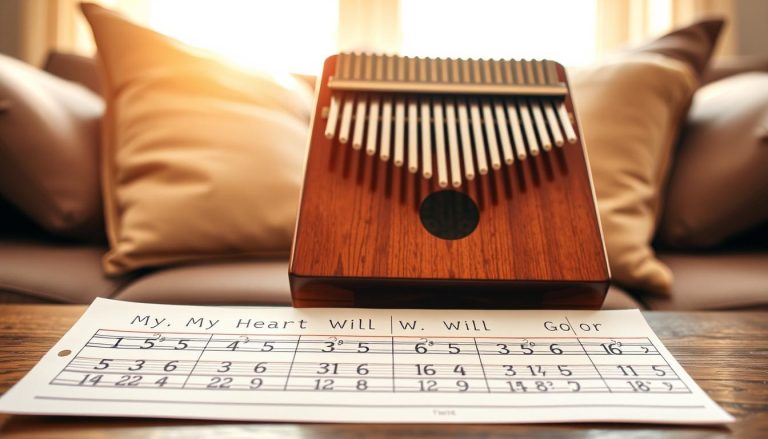
Goal: this tutorial guides you step by step through playing Zelda’s Lullaby on a 17-key thumb piano. A simplified version for beginners, with a clear, progressive method.
By the end, you’ll be able to play the notes in the right order, keep a gentle tempo, and compare your performance with an audio reference. A little preparation—reading the sheet music and tuning—will keep you from practicing on an out-of-tune instrument.
The method combines preparation—tuning and locating the tines—with learning one phrase at a time, then reinforcing what you’ve learned with downloadable resources. You’ll find sheet music and detailed tabs through this link: 17-key sheet music.
Note: the melody can also be played on the ocarina and other instruments. Before memorizing it, check the tuning and mark the tines so you don’t learn the wrong notes.
Before you play: prepare your kalimba and understand the notation
A good sound starts with accurate tuning and a clear understanding of the musical symbols. Take a moment to check your instrument before each session: this prevents you from learning a melody on an out-of-tune instrument and helps you stay motivated.
Tune your 17-key kalimba to play in tune
Quick check: play the center note, compare it with a reference—a tuning fork or an app—and correct it if necessary. Adjust it gradually, then check it again.
Read sheet music: numbers, letters, and solfège
There are three common formats: numbers from 1 to 7, letters C, D, E… and solfège do, re, mi. They all convey the same information; choose the one that works best for you.
Octaves and tab symbols
A dot above a note often indicates the higher octave. Parentheses indicate notes played together to create a small chord.
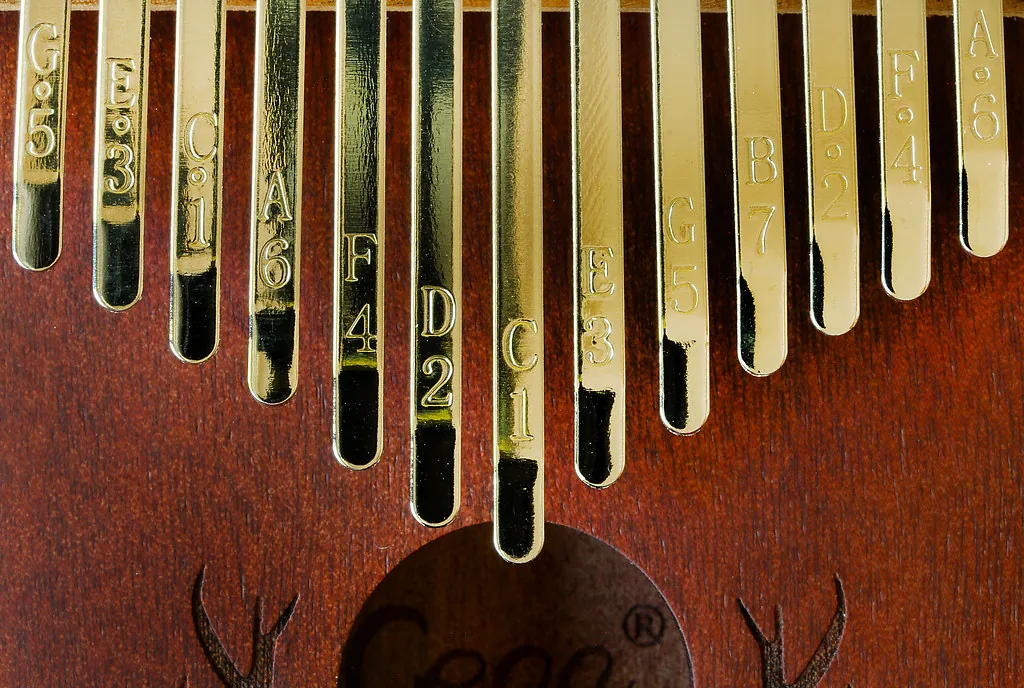
- Markers: engrave the notes or add labels so you can quickly match the tines to the notes.
- Mental map: memorize the center tines and the notes that occur often in the piece.
- Self-check: if a note sounds strange, check the tuning first, then the octave.
| Element | What it means | Quick action |
|---|---|---|
| Dot above | Higher octave | Play the same note one octave higher |
| Parentheses | Simultaneous notes | Pluck both tines together |
| Numbers and letters | Alternative notation | Choose the format that is clearest to you |
For sheet music you can use right away, consult this 17-key score and mark your tines before you begin.
Zelda kalimba tabs: learn Zelda’s Lullaby step by step
Keep it simple at first by breaking the melody into sections. Practice two measures at a time, and increase the speed only when you can play each section correctly.
Simplified note sequence and how to read it
Here is an example sequence in letter notation to guide your practice:
E G D C D E G D E G D^ C^ G F E D / E G D C D E G D E G D^ C^ G^ / G^ F^ E^ F^ E^ C^ E^ D^ C^ D^ C^ A / G^ F^ E^ F^ E^ C^ E^ G^
Reminder: the ^ symbol indicates the higher octave. Practice each line slowly, at around 80 BPM.
Letter notation and the key of C major
Letter notation makes the melody easier to memorize. Find the corresponding tines and follow the sequence in your mind. In C major, you avoid sharps and flats and can focus on musical expression rather than technique.
Playing tips and common mistakes
- Progress: master each phrase at a slow tempo before joining them together.
- Touch: play gently and let the notes breathe.
- Metronome: use one to correct your rhythm.
- Mistakes: if a note sounds wrong, check the tuning and octave first.
| Problem | Likely cause | Quick fix |
|---|---|---|
| Wrong note | Incorrect tuning or misreading the octave | Check the tuning and the marker on the tine |
| Uneven rhythm | Playing too fast | Break up the melody and use a metronome set to 80 BPM |
| Awkward transitions | Not preparing for the next note | Isolate the transition and repeat it slowly |
| Losing your place | No tine markers | Mark the tines or follow 17-key sheet music |
Sheet music, tabs, and practical resources to download
PDF files and reference recordings make it easier to work on each musical phrase.
Downloading the sheet music as a PDF lets you practice offline, write in fingerings with a pencil, and highlight difficult passages. Print the page, mark the octaves, and track your progress from session to session.
Video tutorial and listening reference
Watch the “sheet music played” video to adjust your phrasing and note lengths. Then listen to the original version to understand its gentle, unhurried, lyrical character.
“Listen to a phrase, then play it back immediately”: a simple way to strengthen your musical memory.
Convert tabs to solfège or letters
Converting tabs to do, re, mi or letter notation makes them easier to use on other instruments. For example, adapt the sequence for a piano, flute, or ocarina while keeping the same notes and octaves.
Practical examples include converting the notes to letters for a keyboard, to solfège for a flute, or to an arrangement specifically for the ocarina. This reduces reading errors and preserves the melody’s structure.
Recommended practice method
- Read the notes silently.
- Play slowly, then repeat difficult measures 10 to 20 times.
- Alternate 30 seconds of focused listening with an immediate attempt to play what you heard to improve rhythmic accuracy.
To download a ready-to-use PDF and add other resources to your practice, see a dedicated score and ocarina guide through this link: sheet music and ocarina tutorial. For examples of tabs and arrangements, also consult these tablature resources.
Zelda’s Lullaby: origins, composer, and related instruments
The origins of this melody reveal an unexpected mix of influences. Koji Kondo, a longtime Nintendo composer, wrote this theme, which became an emotional leitmotif throughout the series.
Key cultural detail: Kondo drew some inspiration from Mort Garson’s electronic piece “Concerto for Philodendron & Pothos” (1976), from the album “Mother Earth’s Plantasia.” Listening to the two pieces in succession helps you hear their melodic similarities.

When do you hear this theme in the games?
It first appears in 1991 in “A Link to the Past.”
It later returns in key installments: Ocarina of Time, Twilight Princess, Skyward Sword, and Majora’s Mask. The melody often accompanies moments of calm, royalty, or mystery.
Which instrument should you choose for your goal?
Your choice depends on the sound you want:
- Ocarina: ideal for capturing the theme’s “mythic” quality through breath and legato playing.
- Piano: perfect for studying harmony and playing chords precisely.
- Other instruments: favor those with sheet music or tabs suited to your level.
| Goal | Recommended instrument | Main advantage |
|---|---|---|
| Capture the melody’s mythic character | Ocarina | Expressive breath control and lyrical phrasing |
| Practice harmony and fingering | Piano | Rich harmony and tempo control |
| Convenience and portability | Simple instruments | Easy to learn and carry |
Whichever instrument you choose, follow the same method: keep a steady tempo, practice in sections, and listen to a reference to create a faithful, polished performance.
Conclusion
With a clear routine, you can master this melody quickly. Begin by carefully tuning your instrument, get familiar with the notation, then work through the simplified version one phrase at a time.
A realistic plan: spend 10 minutes a day on two or three phrases, then put them together. Work on a gentle touch, sustaining the notes, and keeping a steady beat with a metronome.
Things to check before playing the whole piece: a tuned instrument, correct octaves, a steady tempo, smooth transitions, and a satisfying comparison with the audio reference.
Once you’ve mastered the melody on the kalimba, transpose it and explore other sounds. Record your version, identify one thing to improve—rhythm or note attacks—and devote a session to it.
For more sheet music and a practical guide, consult an easy score and useful tabs: sheet music and guide and arrangement resources.