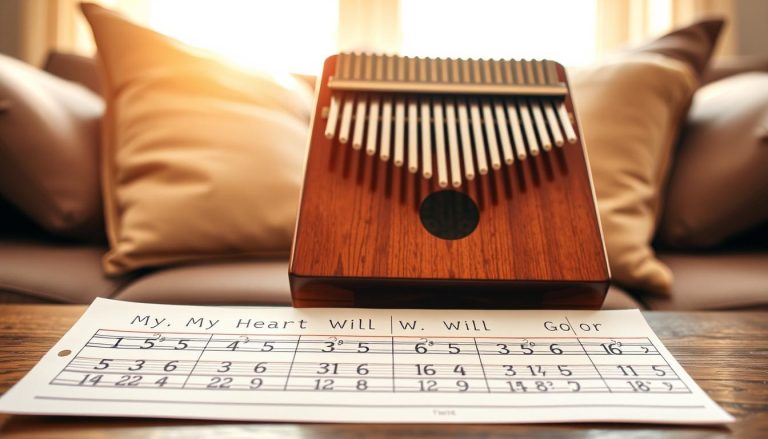
What to expect: this article helps you get started with this African instrument (mbira/sanza) and quickly enjoy playing it.
A clear format: a list of 15 songs grouped by category — nursery rhymes, classics, pop, films/Disney, and gentle challenges — with practical tips to help you get past sticking points.
Who this is for: adults, teenagers, and children with an adult in France, with no knowledge of music notation. You will find simple numbered tabs and a step-by-step method.
You will learn to tune the instrument, find the tines, and read numbered tabs before exploring the song selection.
Step-by-step learning: start with tunes that use just a few notes, gradually increase the difficulty, and try simplified versions to reach the next level. Practice for 10 to 15 minutes a day with a metronome or recordings to track your progress.
Legal resources (printable PDFs and French-language websites) appear later in the article.
Why this thumb piano is ideal for beginners in France
For beginners, the thumb piano offers almost instant access to melody. The tines alternate from the center outward, helping you find notes without too much effort.
An intuitive instrument
Pluck the tines with your thumbs to produce a clear sound, with no complex technique required. The learning curve is quick: just a few minutes are enough to recognize a melody.
17 keys or 21 keys: which should you choose?
The 17-key model in C major remains the recommended starting point. It works with most French-language tabs and lets you play familiar tunes quickly.
The 21-key model offers a wider range and more harmonic possibilities. It does, however, take more familiarity and practice.
A soothing sound that encourages practice
The bell-like tone stays gentle even when your playing is imprecise. This relaxing quality encourages regular practice, which is ideal for making progress.
| Criterion | 17 keys | 21 keys |
|---|---|---|
| Best for | Beginners, simple melodies | Intermediate players, wider range |
| Choice of tabs | Excellent (in French) | Good, but less common |
| Portability | Very compact | Compact, but bulkier |
| Recommendation | Recommended choice for beginners | A good choice for expanding your repertoire |
To find sheet music and printable PDFs in French, consult a practical resource such as this article. In France, the availability of French-language sheet music makes the repertoire easier to explore.
Prepare your kalimba before playing: tuning, keys, and sound quality
Before playing a tune, take time to prepare the instrument. Accurate tuning makes tabs easier to follow and every piece more pleasant to hear.
Tune it in a few simple steps:
Tuning a 17-tine instrument with a tuner app: the basic steps
Open a tuner app and find a quiet place. Start by plucking the central tines, then work outward.
To raise a note, push the tine inward. To lower it, pull the tine slightly. Always make small adjustments.
Common mistakes and small adjustments
Avoid forcing a tine or correcting several semitones at once. Then check the overall harmony and listen for beats between nearby notes.
| Step | Estimated time | Practical tip |
|---|---|---|
| Open the app and find a quiet place | 1 to 2 minutes | Choose a quiet spot |
| Adjust the central tines | 3 to 5 minutes | Make a series of small adjustments |
| Check and fine-tune | 1 to 2 minutes | Test chords and listen to the quality of the sound |
A resonant wood body (mahogany, acacia, or walnut) gives the sound more warmth and helps you hear your progress. The aim is to get a clean sound before moving on to tabs.
Understand the note layout: essential landmarks on the tines
A clear picture of the keys reduces hesitation and speeds up learning. This guide explains the layout that makes melodies intuitive.
From the center outward: find notes easily
On a standard model, the low notes are in the center and the notes get higher toward the outside.
The layout alternates: one tine on the left, one on the right, then another on the left. These landmarks help build muscle memory.
Stickers, numbering, and reading intervals
At first, add small markers or number the tines. This reduces hesitation when reading numbered tabs.
- First, identify the central tine.
- Learn how the tines alternate between left and right.
- Practice feeling the intervals and finding neighboring tines.
- Play 1-2-3-2-1 forward and back.
- Repeat slowly, then speed up.
“A good visual marker and an attentive ear help you avoid plucking the wrong tine.”
| Method | Benefit | Tip |
|---|---|---|
| Numbering | Quickly read the numbers | Add small, unobtrusive number stickers |
| Colored stickers | Instant visual landmarks | Use no more than two or three colors |
| Muscle memory | Look at the instrument less often | Practice the 1-2-3-2-1 exercise |
These landmarks make tabs easier to read and will help you in the lessons ahead. Work on accuracy: your ear often catches what your eye misses.
Read kalimba tabs and sheet music: an easy method without music theory
Knowing how to read numbered tabs is often enough to play a melody without knowing music notation. The numbers correspond to the tines: for example, 1 = C (in C major). Reading direction varies by format but often goes from bottom to top.
Reading numbers: first, find the numbers engraved or marked on your instrument. Play very slowly, matching each number to its tine. Take it one step at a time.
Chords and stacked notes
When several numbers are aligned vertically, they form a chord: pluck the corresponding tines at the same time. This creates a fuller sound and gives the melody harmonic support.
Rhythm and pulse
Rhythm is the most important skill. Count quietly and use a metronome from the start to keep a steady pulse. Begin slowly and increase the speed only when you can play correctly at the slower tempo.
- Choose a short section (4 to 8 bars).
- Practice it slowly with a metronome.
- Increase the speed in stages once you can play it correctly.
Tip: listen to the original song to follow the melody, notice where the phrases breathe, and avoid mechanical playing. The kalimba sheet music below follows this method.
To develop your playing and find more resources, consult a complete guide such as everything you need to know.
Easy Kalimba: 15 Familiar Songs to Play from Your First Days
These songs are grouped by ease of play and learning value.
The path runs from very short tunes (3 to 5 notes) to longer but still approachable melodies. “Playable within a few days” means repetitive patterns, the C major scale, and only a few chords to begin with.
Structure and technical benefits
For each song, focus on the skill it develops: alternating thumbs, transitions, resonance, arpeggios, or keeping time.
- Nursery rhymes: confidence and familiarity (for example, Twinkle, Twinkle, Little Star; Happy Birthday; and Mary Had a Little Lamb).
- Classics: phrasing and expression (Amazing Grace, Ode to Joy).
- Pop and films: motivation and simplified versions that sound good on a thumb piano.
- Gentle challenges: simplified versions that help you take the next step without getting discouraged.
A quick method for the first few minutes
Learn the introduction or chorus first, spending 5 to 10 minutes on it. Then extend the section once you can play it correctly.
- Play the short version with a metronome.
- Try it again without the metronome.
- Finally, play along with the original song to train your ear and enjoy the music.
“Always aim for a beautiful sound before trying to play faster.”
Nursery rhymes and traditional tunes: perfect melodies for your first days
Children’s melodies are excellent practice for thumb coordination. They repeat, use few notes, and often stay on the central tines.
Why these nursery rhymes speed up learning
Repetition: the tune sticks in your memory quickly.
Few notes: fewer mistakes.
Alternating thumbs: the movements become automatic.
Practical examples
Twinkle, Twinkle, Little Star: work on each note to get a clear sound from the central tines.
Mary Had a Little Lamb: focus on alternating thumbs, a useful skill for almost every tab.
Row, Row, Row Your Boat: start very slowly with a metronome and increase the speed only when you can play correctly at the slower tempo.
Hot Cross Buns: an ideal tune for a first session of just a few minutes and for building confidence.
- Day 1: learn the introduction (about 10 minutes).
- Day 2: play the whole piece slowly.
- Day 3: play without looking, then along with the original recording.
| Goal | Time | Benefit |
|---|---|---|
| Introduction | 5 to 10 minutes | Finding the central tines |
| Complete version | 10 to 15 minutes | Alternating thumbs and coordination |
| Reinforcement | 5 to 10 minutes | Playing without looking |
Tip: let the notes ring, breathe between phrases, and vary the volume slightly.
For more ideas and simple sheet music, explore a selection of beginner tunes here and French songs adapted for instrumental playing there.
Familiar kalimba songs: birthdays, pop, and enduring classics
A small repertoire of familiar tunes turns each practice session into an enjoyable little performance.
Songs to share: these tunes make you want to play for family or friends, even in simple versions.
Happy Birthday
Focus on the central notes and a singing phrase. Play slowly and keep the melody clear.
For a celebration, a short version is often enough and sounds good when you play the central tines accurately.
My Heart Will Go On
Simplify the main melody and practice the transitions slowly. The aim is to play smoothly without rushing between phrases.
Yesterday and Let It Be
Work in two stages: play the melody alone, then add a subtle accompaniment. This helps you understand the chord progressions and enrich the sound.
Perfect and A Thousand Years
Focus on expression: let notes ring, vary their volume, and favor accuracy over speed.
Practical tip: isolate the four difficult bars, repeat them in a loop, then put them back into the full piece.
| Song | Level | Learning goal |
|---|---|---|
| Happy Birthday | Beginner | Phrasing and central notes |
| My Heart Will Go On | Beginner to intermediate | Transitions and melody |
| Yesterday / Let It Be | Intermediate | Chord progressions and accompaniment |
| Perfect / A Thousand Years | Intermediate | Expression and sustained notes |
To find sheet music sorted by level, consult kalimba resources and download tabs suited to your ability.
Film, TV, and cult-favorite music: easy tabs that make you want to practice
Film and TV themes are motivating because they are often easy to recognize. That quick result makes you want to keep practicing.
Harry Potter — isolate the main motif
Tip: start by playing Hedwig’s motif on its own. Practice the phrase until it flows.
Once the motif sounds good, add the next section. This approach keeps you from trying to learn everything at once and helps you progress.
Spirited Away and Up — slow playing and resonance
These tunes call for unhurried playing. Giving each note room to breathe creates emotion without complex technique.
Practice with pauses and listen to the resonance to make the music more expressive.
Zelda, Star Wars, Game of Thrones — a short list of motivating themes
Make a list of three themes and alternate between them. This prevents boredom and keeps you motivated to improve.
A simple rule: one theme = one technical goal (steady tempo, precise transitions, or good resonance).
| Theme | Approach | Goal |
|---|---|---|
| Harry Potter | Isolate the main motif | Fluency and musicality |
| Spirited Away | Play slowly and let notes ring | Expression and pauses |
| Zelda / Star Wars | Beginner versions and a list of themes | Motivation and progress |
Always choose short tabs suited to your level. Instruments du Monde offers printable PDFs and organizes them by level. This gives you reliable French-language sources for tracking your progress.
Learning plan: practice for 10 to 15 minutes a day to see progress
A short, focused routine helps you improve with every session. This plan is for kalimba beginners who want to make progress without getting discouraged.
A simple routine
2 minutes of warm-up: gentle wrist movements and a few notes plucked in the center.
8 to 10 minutes on a short section (4 to 8 bars): practice slowly, one phrase at a time.
2 to 3 minutes of free playing for enjoyment and memorization.
Speed up without tensing up
Start very slowly and aim for accuracy before increasing the speed. Raise the metronome tempo in stages.
If your hand tenses or the sound becomes harsh, stop, relax your shoulders, and start again more slowly.
Record yourself and measure your progress
Make a short recording at the end of each session. Compare recordings from one week to the next to measure your progress.
Simple goals: one nursery rhyme in 3 days, one film theme in 7 days, and a simplified pop song in 14 days.
Reliable online resources: kalimba sheet music, tutorials, and useful tools
Finding reliable resources saves you time wasted on incomplete or incorrect tabs.
Pandacréatif offers a very large catalog: about 345 free tabs. It is ideal for building a varied repertoire and trying different styles.
Free sheet music and print-ready PDFs
Instruments du Monde offers 41 articles and downloadable PDFs, organized by level and theme. The files are clear and rated (an average score of 4.6/5), making it easier to choose.
Practical tip: filter results by “beginner,” choose short versions, and print them on A4 paper at 100%. Then file them by difficulty in a binder.
Essential apps and tools
Recommended tools: a smartphone tuner, a metronome, a recording app, and a tab editor. These tools make tuning and reading easier.
A simple method: quick tuning → metronome at a slow tempo → 30-second recording → mark difficult passages on the sheet music.
Communities, tutorials, and learning together
Watch video tutorials to observe hand movements and join French-speaking groups for feedback. Other players can often help you correct your posture and rhythm.
“Consult a guide and tutorials before settling on a method: this helps you avoid recurring mistakes.”
| Resource | Content | Benefit |
|---|---|---|
| Pandacréatif | About 345 free tabs | Wide variety, ideal for changing up your repertoire |
| Instruments du Monde | 41 articles and printable PDFs | Organized by level, 4.6/5 rating |
| Apps | Tuner, metronome, recording | Better tuning and a steady rhythm |
To add to these resources, 17-tine kalimba sheet music offers print-ready versions suited to beginners. Use the guides and resources mentioned to plan your sessions and progress with confidence.
Conclusion
In short, this instrument lets you play beautiful melodies quickly and encourages regular practice. The kalimba can produce a pleasant sound from your first sessions.
A method that works: tune the instrument, mark the tines, read numbered tabs, then practice for 10 to 15 minutes with a metronome while recording yourself.
Working on familiar tunes will build your fluency and confidence. Accurate tuning and a light touch immediately improve the quality of the sound.
Next step: choose 3 pieces (a nursery rhyme, a pop song, and a film theme) and spread your practice over 7 days. Use legal sheet music and reliable tutorials, such as this useful selection: top 10 easy songs.
Final tip: save this article, print two tabs, and play your first melody today to get started.