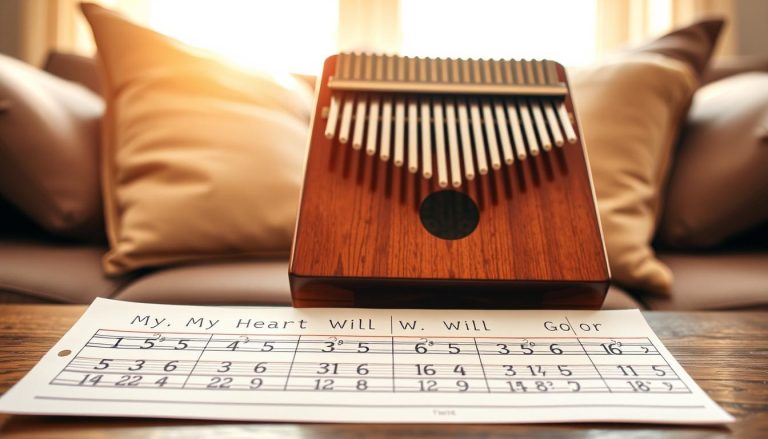
Welcome: this guide helps beginners get started with a small traditional African instrument made famous by Hugh Tracey.
This guide is for complete beginners, parents, and educators looking for simple, engaging melodies. The goal is clear: play a first song correctly with a steady rhythm.
The guide covers how to hold the instrument, tune it to C major, read tabs, and play popular songs such as “Au clair de la lune” and “Happy Birthday.”
It briefly explains the instrument’s African origins and why it suits repetitive melodies that are easy to remember.
You will also learn useful terms: tines, notes, octave, tempo, thumbs, and sound box. Tip: avoid common mistakes, such as playing an out-of-tune instrument.
To follow the complete method and access progressively arranged sheet music, learn more here.
Why choose an 8-tine kalimba for a gentle start?
A smaller instrument makes the first melodies easier to learn. Fewer notes to remember mean simpler movements and quicker progress.
For beginners, this can bring a sense of achievement from the first few sessions. One octave is enough to play many songs and single-note melodies without difficulty.
A melodic, portable, accessible instrument
A gentle tone makes playing enjoyable: it is ideal for lullabies and short melodies. The instrument is light enough to play anywhere for a few minutes a day, with no complicated setup.
Comparison: simplicity and a wider range
The choice between a compact and a larger instrument depends on the music you want to play. One octave is an excellent starting point for working on rhythm, expression, and accuracy.
| Criterion | Compact instrument | Wider-range instrument |
|---|---|---|
| Range | C–C (1 octave) | Extended range (more octaves) |
| Number of notes | 8 notes: easier to remember | 17 notes or more: more harmonic possibilities |
| Reading music | Tabs are easier to read | More complex notation and chords |
| Recommended use | Beginners and simple songs | Advanced players and varied repertoire |
What C–C tuning (C major) makes possible
Standard C major tuning (C, D, E, F, G, A, B, C) is enough to learn the scale degrees and follow numbered tabs. In practice, having fewer notes does not prevent expressive playing: rhythm, a slight glissando, and changes in volume add interest.
If you want to get started quickly, consult this complete resource to help you progress: a beginner method and sheet music.
This simple choice helps prevent bad habits, provided you learn how to hold the instrument properly. The next section explains the essential movements for getting started.
How to hold the instrument without developing bad habits
Set yourself up properly so that practice stays comfortable and effective. Holding the instrument well prevents fatigue and reduces mistakes from the first few days.
Posture, hand position, and sound box stability
Sitting upright with relaxed shoulders and flexible wrists helps you play consistently. Resting the instrument in your palms without blocking its sound holes preserves the resonance of the sound box.
Place your fingers behind the instrument to support it and tilt it slightly toward you so the tines remain accessible. This position keeps it stable and makes thumb movements easier.
Using your thumbs: a precise stroke and clear sound
Strike the tines at right angles to their edges: pluck them, then release them without pulling. This limits rattling and improves the clarity of each note.
Control your force to avoid striking too hard. An even touch gives you better control of volume and reduces unwanted noise.
Finding the tines and remembering the notes
Play the tines one at a time to connect each one visually and mentally with its note. Alternate your left and right thumbs to develop coordination.
- Routine: play one note slowly, then listen to it vibrate.
- Mini exercise: play arpeggios, alternating thumbs on the central tines.
- Common mistakes: tension, an unstable instrument, and playing too fast — correct them by slowing down.
| Goal | Action | Result |
|---|---|---|
| Stability | Rest the instrument in your palms, supported by your fingers | A stable sound box and better resonance |
| Accuracy | Strike at a right angle, pluck, then release | A clear note with less rattling |
| Coordination | Play arpeggios, alternating left and right thumbs | A steady rhythm and better volume control |
To progress step by step, follow a beginner method and repeat these short exercises every day. This practice will quickly improve your playing and support your learning.
Tuning an 8-tine kalimba to C major so it sounds right from the start
Tuning the instrument properly lets every melody sound right from the first note. Without good tuning, even a correctly read tab will sound wrong and may discourage you.
A clear target: aim for standard C major tuning (C–D–E–F–G–A–B–C). It provides the basis for most of the songs here and makes the notes easier to read.
Basic equipment: an electronic tuner in chromatic mode or a reliable app, a small tuning hammer, a stable surface, and a quiet setting for accurate readings.
Step-by-step method
- Pluck a tine and let it vibrate. The tuner will display the note.
- Slide the tine upward to lower its pitch, or downward to raise it.
- Make small adjustments with short, controlled movements, without striking too hard.
- Start with the reference C, then work up the scale to the high C.
Check: go through all the notes a second time, correct small differences, and aim to get as close to 0 cents as possible.
Practical tip: retune the instrument regularly after a change in temperature, travel, or a knock. To make progress, follow the recommended method and check the tuning before each session.
How to read tabs and sheet music for an 8-tine kalimba
Understanding the different notation systems makes reading music easier. Here are three formats you will encounter and a simple way to connect them to your instrument.
Numbered notation (NMCA): 1 = C, 2 = D… 7 = B. Writers sometimes add octave symbols (°, *, ‘) to specify the register. Read these signs carefully to play the note in the correct octave.
Letter notation: C, D, E, F, G, A, and B correspond to the notes of the C major scale. This system makes transposition and simple chords easier to understand.
Vertical tablature: read it from bottom to top. Notes that line up should be played together, making it easy to spot chords or pairs of notes.
For rhythm, check the time signature (such as 4/4), the tempo in BPM, and the note values (quarter notes and eighth notes). In numbered notation, 0 marks a rest. Identify the key and recurring patterns, then play slowly with a metronome to improve accuracy and avoid speeding up.
- Mini exercise: read a line in NMCA, convert it to letters, then picture it as vertical columns.
- Next, apply this method to music arranged for the C–C octave to strengthen your reading skills.
8-Tine Kalimba: Easy Sheet Music and Children’s Songs
This collection brings together short, familiar melodies suited to a single octave. Choose sheet music or tabs that stay within the C–C range. Repetitive tunes are easier to remember and enjoyable to play.
Easy children’s songs and classics
Au clair de la lune is an ideal piece: its phrases are simple and its melody is easy to recognize by ear. Work on sustained notes and a steady rhythm for a clear sound.
Working on accuracy
Happy Birthday helps you work on accuracy one note at a time. Break it into short phrases and repeat them slowly.
Seasonal songs and progress
We Wish You a Merry Christmas fits well within the C–C octave. Use a metronome to avoid speeding up during the chorus.
Going a little further
Petit Papa Noël may call for simple two-note chords. Check the tuning before trying to play notes together.
Technical goal
You Are My Sunshine helps develop thumb coordination and smooth connections between notes. Add small changes in volume to make the melody expressive.
| Piece | Learning goal | Level | Practical tip |
|---|---|---|---|
| Au clair de la lune | Recognizing the melody by ear; simple phrases | Beginner | Sustain notes and play slowly |
| Happy Birthday | Accuracy and short phrases | Beginner | Break it into phrases |
| We Wish You a Merry Christmas | Repeated patterns and rhythm | Beginner | Use a metronome for the chorus |
| You Are My Sunshine | Thumb coordination and phrasing | Intermediate | Use expression and a few pairs of notes |
Use the same method for each piece: read → sing → play very slowly → steady the rhythm → increase the speed once you can play it well. Master one song before adding another.
Playing a melody accurately: a step-by-step learning method
The key to accurate playing is to divide the melody into small sections. Work on each one- or two-bar section until you can play it well.
Divide the music into short sections and join them together
Repeat one section 5 to 10 times, then add the next. Join them gradually so you can keep track of the piece’s structure.
Keep a steady beat with a metronome and gradually increase the tempo
Start at a tempo that lets you play without mistakes. Then raise it by 5 BPM per session, only after several error-free attempts.
Record yourself to correct notes, rhythm, volume, and accuracy
An audio or video recording reveals timing problems, wrong notes caused by poor tuning, a lack of expression, and rattling when you strike the tines. Listen back and note two or three things to improve.
A typical 20-minute routine: 5 minutes of warm-up, 10 minutes of focused practice, then 5 minutes playing the whole piece at a controlled tempo.
A measurable goal: play 8 bars without mistakes at 60 BPM before increasing the tempo. To follow a beginner method and keep progressing, apply the tips below.
Simple techniques to enrich your pieces (chords, glissando, expression)
A few basic techniques can turn a simple tune into a lively performance. The aim is to add color and expression without making it difficult to play.
Easy chords and harmony
Play two or three aligned notes to make a clear chord. Place it at the beginning or end of a phrase. Combine nearby notes for a gentle sound.
Try inversions: change the order of the notes to vary the sound without changing the melody.
Glissando, slides, and vibrato
Slide your thumb across adjacent tines for a harp-like effect, using slightly longer nails if needed. Control the speed to keep the rhythm steady.
For vibrato, make a small side-to-side movement after striking a note. Keep it gentle: too much movement affects the tuning.
Volume and tone control
Vary the volume: play softly, add an occasional crescendo, or strike a little more firmly to highlight a phrase. Avoid using too many effects.
A gradual method: add just one effect to a passage, check your accuracy with a metronome, then combine effects.
Current resources for free sheet music and tabs online
A few simple guidelines will help you find good free tabs. Look for clear formats: printable PDFs for practice and step-by-step videos that show fingering and tempo.
Useful formats:
- PDFs organized by key and level (C major is compatible with the C–C octave).
- Slow video tutorials that show bars and finger positions.
- Online collections organized by difficulty so you can choose suitable melodies.
Communities and sharing
Joining a forum or group lets you share files, get feedback on your reading, and discover inspiring songs, such as film themes and standards. Prompt feedback can help you correct your reading and rhythm.
Adapting a song to the C–C octave
Check the lowest and highest notes. If a note is outside your range, play the same note in another octave, use a passing note, or rewrite a short phrase to preserve the rhythm.
“Before judging a resource, tune your instrument: even a good arrangement will sound wrong on an out-of-tune kalimba.”
Simple organization: create folders (beginner, Christmas, films), note a comfortable tempo, and save useful files. To learn more, follow this guide and practice for a few minutes each day.
Conclusion
Here is a clear summary to help you turn curiosity into regular practice.
Start by choosing a compact kalimba, then focus on how you hold and strike it and on tuning it to C major. Learn to read tabs and sheet music before adding more songs.
Two priorities: notes that sound right through careful tuning and a steady rhythm through metronome practice. Together, they make any melody more enjoyable to hear.
Practice for a few minutes each day. Record yourself, identify one thing to improve first, and play again: it is an effective way to progress.
A simple path: one children’s song, one classic, one Christmas song, then a richer piece. After that, add chords, glissandi, and expressive changes in volume.
When one octave is no longer enough, consider moving to a 17-tine kalimba while keeping the smaller one for accuracy practice. This article gives you the guidance to improve with enjoyment and build a solid repertoire.