This guide traces the earliest evidence of a small African instrument often called the thumb piano.
Dating back more than 3,000 years, it belongs to the family of instruments with vibrating tines. Its history runs from bamboo and wooden models to the adoption of metal tines in modern music.
In the 1950s, Hugh Tracey reworked the instrument for Western audiences. This “second invention” led to its standardization in the following years and to international recognition, including UNESCO recognition in 2020.
By reading this article, you will learn how to tell its story, recognize its varieties and choose a suitable model. Simple, useful and practical, the text follows a clear sequence: ancient origins, adaptations, standardization and contemporary uses.
Origin of the kalimba: the instrument’s history, culture and evolution
Its intimate sound is captivating from the first notes played with the thumbs. Its tone is gentle, almost meditative. Many see it as a little pocket piano that is easy to pick up and play.
Why it fascinates people
- Easy to pick up: you can produce a melody with just a few movements.
- Warm, quiet tone: ideal for calm settings.
- Playing with the thumbs, often using the nails, creates a meditative feeling.
- Organological classification: an idiophone classified among percussion instruments, yet melodic like a miniature piano.
What you will learn
In the following sections, you will discover its origins, regional names (mbira, sanza, likembe…), materials (wood, metal, acrylic) and tunings (diatonic, chromatic).
“A small movement of the thumbs can soothe the mind and create soundscapes.”
Useful vocabulary: tines (blades or keys), resonator. The instrument first played a social and spiritual role, then spread worldwide as a solo, accompanying and studio instrument.
The thumb piano’s African origins: earliest evidence more than 3,000 years ago
The earliest archaeological evidence places this instrument on the West African coast more than 3,000 years ago. Discoveries point chiefly to the area of present-day Cameroon. These remains are scarce, but they offer a glimpse of ancient musical practices in sub-Saharan societies.
Before metalworking was established, makers used wood and bamboo to make the tines and keys. These materials produce a soft, delicate tone. They project less sound than metal tines and respond strongly to changes in humidity.
The fragility of these objects explains why they have often disappeared. Bamboo and wood decay quickly, especially in tropical climates. Excavations therefore yield few remains, and conclusions remain cautious.
This lack of surviving material creates a gap in the chronology. It is not always possible to connect these ancient prototypes to later forms. The scarcity of archaeological sources leaves some questions unanswered.
“Perishable materials have erased part of the story; the ‘second invention’ would come later, with metal tines.”
The “second invention”: the kalimba’s return in the age of metal tines
Around the eighth century, a revival took place near the Zambezi: makers replaced bamboo with metal to create more stable keys.
This move to metal tines increased durability and stabilized tuning. Metal tines transmit vibrations more effectively and offer greater resonance.
The change also altered the instrument’s social use. In several regions, its forms diversified and acquired names such as likembe and mbira.
Among the Shona, the instrument plays a central role in ceremonies, weddings and rituals intended to communicate with ancestors. Repeating patterns benefit from greater sound projection.
“The strength of metal extended the musical and social life of these instruments.”
Comparing materials and their effects
| Material | Durability | Sound quality | Social use |
|---|---|---|---|
| Bamboo and wood | Low | Soft sound, limited projection | Local use, small ceremonies |
| Metal (metal tines) | High | Greater resonance and vibration | Regional spread, travelling musicians |
| Modern forms | Very high | Controlled projection | Stage, studio, teaching |
To learn more about this transformation and the spread of different models, read this historical overview: historical evolution.
Mbira, sanza, likembe… understanding the names and the instrument family
The same acoustic principle appears under a mosaic of names across Africa.
In Africa, this instrument has many names depending on the region: mbira (Zimbabwe), likembe, sanza or senza (Cameroon, Congo), karimba (Uganda), okeme and other local variants.
This diversity reflects differences in shape, repertoire and social use. Some mbiras are used in ceremonies; others accompany secular songs.
Kalimba: a word that went global
The term kalimba became established in the twentieth century as the instrument spread in the West. Today, throughout the world, it often refers to modernized, standardized versions.
When buying a “kalimba” in France, you will often find a 17-key model. This model draws inspiration from some traditional mbiras, but differs from them.
A simple way to understand them
Instead of looking for a single definitive name, think of a family of instruments with tines. This helps distinguish local variants from modernized forms.
“Thinking in terms of a family avoids confusion between traditional heritage and commercially produced instruments.”
| Name | Region | Characteristic |
|---|---|---|
| Mbira | Zimbabwe | Ritual use, complex repertoires |
| Sanza or senza | Cameroon, Congo | Various forms, vocal accompaniment |
| Likembe | Central Africa | Small portable forms, music for social occasions |
| Karimba | Uganda | Local models, distinctive sound textures |
For a closer look at the distinction between these names and how they spread, read this overview: differences and origins.
Encountering the West: the first written descriptions in the sixteenth century
Around the turn of the seventeenth century, accounts by European travellers offered a concrete picture of a small instrument with tines found in southern Africa.
João dos Santos, a Dominican missionary, travelled in 1586 through the region that includes present-day Mozambique and neighbouring areas. His account appeared in 1607 in Ethiopia Oriental. He described an instrument called the “ambira” in detail.
What do the sources say?
Dos Santos mentions nine metal keys fixed to a wooden support. This description confirms that metal tines were already in use at the time.
He emphasizes the “soft and pure” sounds and the low volume. The use he describes suits intimate settings more than large ensembles.
Technique and significance
The account says that playing required fingernails long enough to make the tines vibrate. This detail sheds light on the playing technique and how musicians shaped the tone.
“A small set of nine tines, with a delicate, restrained tone.”
These written accounts did not invent the instrument, but they provide useful descriptions for researchers. Modern standardization of the thumb piano would come only in the twentieth century.
Hugh Tracey and the birth of the modern kalimba in the 1950s
Hugh Tracey, a British ethnomusicologist based in southern Africa, carried out extensive fieldwork to document instruments with tines and adapt them to Western musical practices.
His approach sought to make the instrument more stable and accessible. He standardized a diatonic tuning (from C to B) to make it easier to share written notes and teach the instrument.
The 15-tine model and diatonic tuning
A major development was the adoption of a 15-tine model tuned to G major. This choice made the scale easy to understand and use for simple melodies.
With consistent notes, musicians could transpose and play together without having to retune each instrument.
The resonator and acoustic innovation
Tracey transformed the support into a hollow wooden body with a central hole. The resonator amplifies the sound and allows players to create effects by covering the opening.
This design improves projection while preserving the warm tone of the wood.
Distribution, AMI and the education market
To distribute this model, Tracey founded African Musical Instruments (AMI). Sales expanded through partners such as Creative Playthings.
The result was a consistent instrument that was easier to play in schools and homes. It could spread around the world and pave the way for later developments.
“A shared tuning makes music easier to play together. That is the basis for lasting popularity.”
From worldwide popularity to recent developments
In the 1960s, it gained visibility through music magazines and Hugh Tracey’s successors. Its popularity in pop music grew in 1974 with Earth, Wind & Fire’s “Kalimba Story”, which introduced it to a worldwide audience.
Modern standard: the 17-key model in C major became widespread because it is accessible. It makes musicians’ work, quick learning and the use of sheet music easier.
Materials and new forms
Wood remains popular for its warm tones: mahogany, acacia and walnut. Acrylic offers a different appearance and greater durability.
Chromatic versions and brands
Chromatic models offer all 12 semitones and more notes, but are harder to play and cost more. Brands such as Hokema, Gecko and Hluru innovate in quality, ergonomics and accessories designed to protect the fingers and improve vibration.
“These developments make the instrument more versatile when played with other instruments, from folk music to studio recordings.”
- What to consider when choosing: number of keys, material, finger comfort and type of tuning.
- To compare models and their uses, read our guide to kalimba vs mbira.
Construction and acoustics: how wood, tines and resonance shape the sound
The combination of the wooden support and the tines determines the instrument’s sound. On a thumb piano, the quality of the body and the precision of its construction affect the clarity and sustain of the notes.
A simple, functional structure
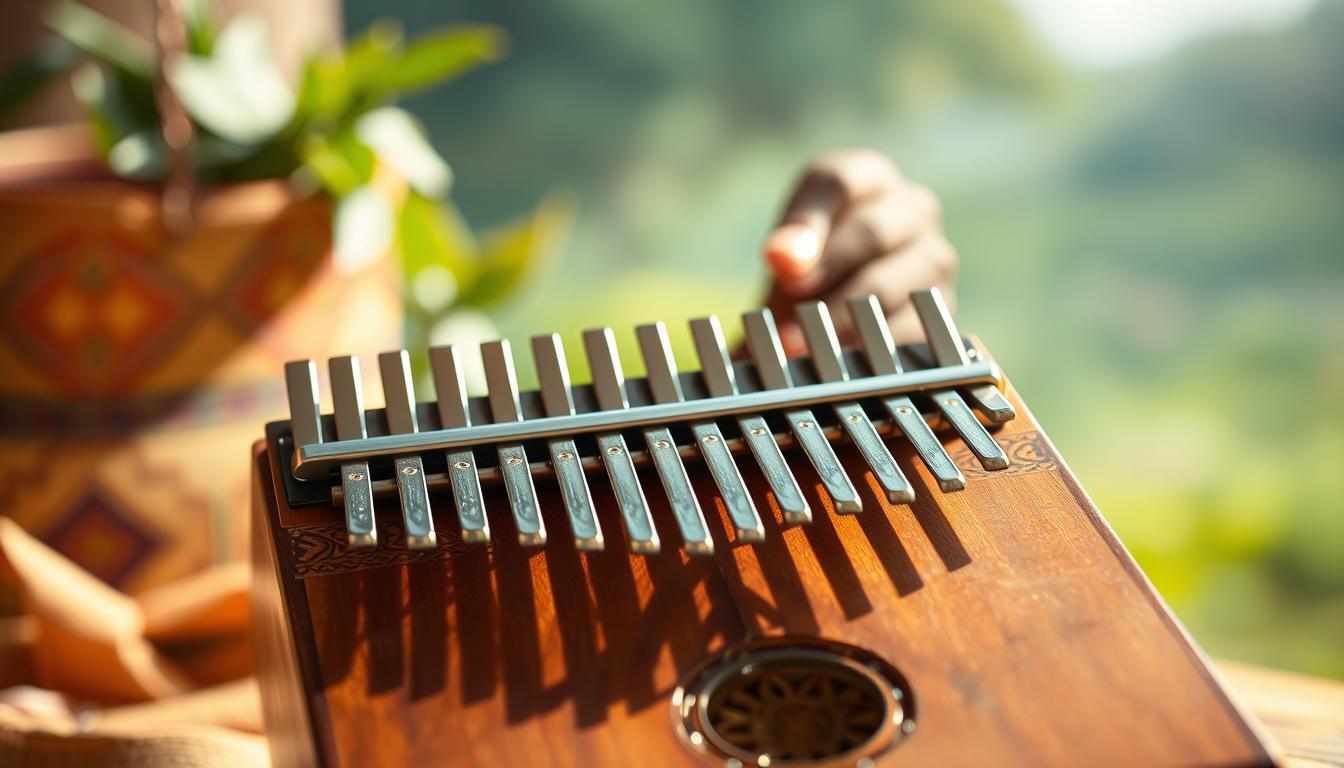
The structure remains the same: a support (board or box), bridges, pressure bars and metal tines of varying lengths.
The tines are held in place, aligned and tuned according to their length to form a playable scale.
How sound is produced
When you pluck a tine, it vibrates and transfers some of its energy to the instrument’s body.
The box amplifies this vibration through resonance.
A “flat” model produces a more intimate sound; a “box” model projects sound more effectively.
Choosing wood and tuning the instrument
Bamboo offers a softer sound. Oak and maple provide more projection and balance. The choice of wood changes the resonance and the tones produced.
The principle behind tuning is simple: the longer the tine, the lower the note.
You adjust the pitch by moving the tines forward or backward. Inaccurate assembly can produce muted notes or buzzing.
Cultural recognition and contemporary uses: from tradition to music therapy
From traditional evening gatherings to modern studios, this instrument retains a distinctive, soothing presence.
Solo instrument, accompaniment and tonal colour
Use: it is often played solo to create an intimate atmosphere. It also accompanies voices, guitars and percussion.
Musicians also use it for tonal colour: a clear texture in folk, ambient, jazz or pop music. Maurice White popularized this tone in funk, opening the way for further sonic experimentation.
Relaxation and music therapy
Its gentle sounds and regular vibrations encourage relaxation. They can help with breathing, refocusing and stress management.
Its accessibility is an advantage in sessions: it provides quick satisfaction and allows people to work on fine motor skills. Simple exercises strengthen thumb coordination and consistency of movement.
UNESCO 2020: recognition and transmission
In 2020, the art of making and playing the mbira was inscribed on UNESCO’s intangible cultural heritage list. This recognition helps safeguard the associated knowledge and encourages its transmission.
“Its tone has been described as mystical, peaceful and enchanting.”
As the instrument spreads around the world, understanding its history and role becomes increasingly important. For another overview of its origins and regional connections, read this summary: origins and regional connections.
Conclusion
In conclusion, this account traces a long journey: fragile forms made of wood and bamboo, a revival through metal tines, early written descriptions and standardization in the twentieth century.
Hugh Tracey made the instrument more accessible without erasing local practices. Today, the kalimba retains a role in cultural heritage while finding a place in modern settings.
Its success rests on two strengths: it is easy to pick up and has enough sonic richness to create musical soundscapes. Its resonance and tuning offer surprising expressive possibilities.
To learn more, explore the mbira, sanza and likembe families, along with our buying advice on where the kalimba comes from.