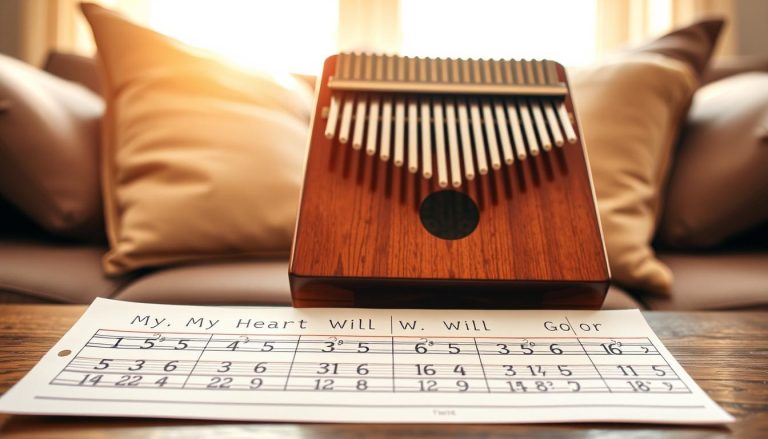
Get quick access to resources designed to help you improve without losing heart. This article offers a clear selection of sheet music and tabs for beginners in France, with A4 files ready to print.
You will find practical advice and a step-by-step method. Downloading, tuning, reading numbered notation and choosing the right level will lead you to your first piece.
The path is simple: tuning → numbered notation → choosing a level → repertoire (nursery rhymes, films, pop, video games, classics) → a 15-minute routine. This method helps beginners stay motivated.
Realistic expectations: you can play a simple melody in your first session. From there, the tabs become more challenging week by week.
Start with short versions to build a solid foundation before tackling full scores. The library is organized by theme and difficulty level to save you time.
Why look for easy-to-print kalimba sheet music when you are a beginner in France?
Starting today with a ready-to-use sheet and a clear guide makes all the difference for a beginner. The most common need is simple: learn to play without reading standard notation and find a resource you can view and print immediately.
Goal: play a familiar song in your first session
Choosing a familiar song helps you find the tempo and remember the sequence of notes. When you play a simple melody, you can quickly hear your progress. That early reward keeps you motivated.
What you will get: clear PDFs, tabs and practical advice
At Instruments du Monde, a guide brings together 41 articles with clear PDF files organized by level and theme, and the site displays an average rating of 4.6/5.
“Ready-to-use resources make practice easier and let you play anywhere.”
- Greater simplicity: easier to read and use on a tablet or music stand.
- Practical advice to avoid common mistakes with rhythm, notes and discouragement.
- A learning path: getting started, a short routine and a small, motivating repertoire.
In France, choose identifiable, legal sources for a relaxed and lasting learning experience.
The 17-key kalimba, or thumb piano: an ideal instrument for learning to play
This small thumb piano is perfect for beginners. Its size combines comfort with a logical note layout. It is an accessible musical instrument that encourages short, regular practice.
How the keys are arranged
The keys alternate on either side of the central tines. This layout helps you find notes quickly and understand tabs. With 17 tines, the range lets you play nursery rhymes, film themes and pop songs without too much complexity.
A warm, clear sound
The wooden body produces a warm, clear sound. Your first melodies can sound good even while your playing is still uneven. This tone is encouraging and helps you hear mistakes.
Posture and grip
Hold the instrument steadily, with relaxed shoulders and wrists in a neutral position. Play mainly with both thumbs, using short movements to limit fatigue. These habits make coordination and memorization easier.
Next steps: tune the instrument, learn numbered notation, then choose a simple score to begin.
Tune your kalimba before using sheet music or tabs
Accurate tuning before every session improves your musical experience. An in-tune instrument prevents the frustration of hearing a wrong note.
Step-by-step tuning with a tuner app
- Install gStrings or another tuner on your phone.
- Find a quiet place and start with the central tines.
- Pluck one tine, read the note on the screen and adjust it gently.
Small adjustments: push or pull the tine without forcing it
Push or pull the tine very slightly to raise or lower the pitch.
If necessary, gently tap its base with a small hammer to make fine adjustments.
Common tuning mistakes and quick fixes
- Adjusting too much: always make small changes.
- Failing to check again: compare neighboring notes.
- Ignoring beats: listen for clashing notes and adjust again.
A quick routine before each session for accurate notes
Two to three minutes are enough: check four to six key notes, then quickly go over the instrument.
Finish by slowly playing a short sequence of notes to check the overall harmony. Once the instrument is tuned, reading tabs becomes much more rewarding.
| Action | Tool | Time | Result |
|---|---|---|---|
| Check the central tines | gStrings | 1 min | Stable central notes |
| Fine adjustments | Hammer or fingers | 30 sec | Accuracy without damage |
| Overall check | Your ear and a tuner | 1 min | Overall harmony checked |
To add to your learning, explore these kalimba resources, which offer guides and files for confident practice.
How to read kalimba sheet music or tabs: a simple numbered method
Numbered notation makes it easier to move from the page to your thumbs. Sheet music may use standard notation or numbers. A tab shows you directly which tine to play.
One number = one tine. The idea is to read the numbers and turn a sequence of notes into a melody without knowing standard notation. First identify the central numbers, then work toward the outer tines.
Vertical tabs and right-hand/left-hand guides
Read the tab from top to bottom. The upper lines represent higher notes and the lower lines represent lower notes.
Use your right hand for odd numbers and your left for even numbers to avoid mixing them up. Keep the central divide in mind.
Rhythm, beats and sustained notes
Count aloud and tap your foot to establish the rhythm. Observe the rests and hold notes for the full indicated duration.
- Read one line.
- Play it slowly.
- Repeat it four times.
- Join two sections.
Use stickers on the keys at first, then gradually remove them to strengthen your ear and memory. Playing slowly and cleanly is better than playing quickly and messily: it is less stressful and more effective.
Easy printable sheet music for 17-key kalimba: a free selection
Short pieces make reading easier and build confidence from the first few sessions.
Start short and simple: begin with a brief sequence to strengthen rhythm and memory. A shortened version lets you repeat a pattern without losing your place.
Filter by level and theme
Choose the “beginner” level until reading feels automatic. Sort by theme too: nursery rhymes, films, pop or video games can help you stay motivated.
How to spot an easy tab
Look for few chords, a manageable number of notes and a moderate tempo. Repeated patterns and simple transitions make learning easier.
Practical rules
- If you get stuck in the same place more than three times, slow down or choose a simplified version.
- Sustained notes and rests call for musical expression: they can make a tab with few notes more challenging.
To find files organized by difficulty and theme, explore the level-based library at Instruments du Monde. It makes legal, ready-to-use PDFs easier to access.
Where to download free, legal tabs as A4 PDFs
A central collection of PDFs makes it easier to find material and prepare your sessions.
Instruments du Monde offers a library of 41 articles you can view and download. These files bring together kalimba sheet music and tabs so you can build a varied repertoire without wasting time.
Quality and trust
The site’s average rating is 4.6/5, reflecting appreciation for its quality and ready-to-use files. You will find familiar themes: nursery rhymes, film music, pop and video games.
Good printing practices
Print on A4 paper at 100% scale and avoid the “fit to page” option. This keeps the markings and numbers on the tab easy to read.
Check the PDF on a tablet or phone first to make sure it is sharp. File your sheets by theme and level in a binder so you can find each piece quickly during practice.
Choose the right sheet-music level: beginner, intermediate or simplified advanced
Choosing the right level makes learning easier and keeps you eager to play. The resources fall into three clear stages: beginner, intermediate and simplified advanced.
Signs you should stay at beginner level and keep improving
Stay at beginner level if you often hesitate over the numbers, your rhythm is unsteady or you constantly look at the keys. Getting tired quickly or making repeated mistakes are other signs.
When to move up
Move to the next level after you can play three or four short pieces cleanly. Look for smooth transitions, steady notes and consistency in your practice. A short recording can help you check your progress.
Build a motivating progression
- Simple nursery rhymes → short film themes.
- Short pop arrangements → rhythmic video-game music.
- Always keep one very easy piece for warming up and avoiding frustration.
To get started and choose suitable files, read our beginner’s guide and adapt each thumb-piano session to your goals.
Very easy nursery rhymes for learning your first melodies
Nursery rhymes are ideal practice material for your first melodies. They combine repeated patterns, a naturally slow tempo and instantly recognizable tunes.
Frère Jacques: thumb coordination and clean repetition
Frère Jacques helps you synchronize your thumbs. Work on short, two-bar sequences.
Repeat each section four times, focusing on consistency rather than speed.
Au clair de la lune: slow tempo, rests and musical phrasing
To play Au clair de la lune, keep the tempo slow. Observe the rests to create a phrase that breathes.
Emphasize the main notes slightly to make the melody expressive.
Happy Birthday: a simple melody to play with family
Happy Birthday is rewarding to play with family and can be learned quickly.
Play it in sections, then join them together and pay attention to tuning.
- Method: two bars → repeat four times → join them.
- Tip for expression: play more strongly on accented beats.
- Next step: once you have mastered these pieces, move on to film themes for variety.
Film and animated-movie music for the 17-key kalimba
Film themes can quickly turn a practice session into a rewarding experience. The melodies are often short, recognizable and playable at a slow pace; the instrument’s resonance brings out every note.
Comptine d’un autre été (Amélie): arpeggios and resonance
Focus on simple arpeggios and sustaining the notes rather than speed. The resonance fills out the sequence and softens minor inaccuracies.
Spirited Away: softness, transitions and glissandos
Work on clean transitions between notes. Add gentle glissandos when the tab allows them to give the music more depth.
Harry Potter (Hedwig’s Theme): the main motif, then the full version
Begin with a short version of the main motif. Once you have mastered it, work through the full score section by section.
Up and Under the Sea: emotion and expression
These pieces call for expressive playing. Vary the volume and emphasis, even with a simple score, to convey emotion.
Tip for working in sections: isolate a sequence of four to eight bars, make it steady, then join it to the next section. If the notes become denser, slow down and use a metronome.
Easy pop songs and romantic melodies for thumb piano
Romantic pop songs offer a motivating repertoire that you can recognize right away in your practice sessions. They encourage a short, regular routine because you can hear the result quickly.
Perfect — a two-week routine
Days 1 to 7: work through each section slowly and cleanly, one phrase at a time.
Days 8 to 14: join the sections and stabilize the rhythm with a metronome set to a slow tempo.
A Thousand Years — dynamics and breathing
Emphasize dynamic contrasts: play some passages more softly and others more strongly.
Breathe between phrases and keep your attack even to preserve the emotion.
Yesterday — bring out the melody
When you add accompaniment notes, make sure the main melody stays clear.
Reduce the accompaniment if it obscures the melody, then gradually bring it back.
River Flows in You and Kiss the Rain — a piano-like touch
Aim for an even touch, sustain selected notes and take care with transitions for a piano-like sound.
Practical tip: always start with a short version (a verse or theme) before printing the full score. Use a metronome set to a slow tempo: romantic pop leaves little room for tempo fluctuations.
Classic video-game and anime themes: motivating pieces for improvement
Classic video-game and anime themes motivate you and give your progress structure. They make repetition appealing and improve consistency without becoming boring.
Zelda’s Lullaby: work on its 12/8 rhythm by counting in groups of three. Establish the rhythm slowly, then gradually increase the tempo.
Lost Woods
Identify the syncopations and divide the sequence into short phrases. Loop each passage until the notes are steady.
Super Mario
Work on consistency with a metronome: a steady tempo immediately reveals any slips. Adjust the tempo, then keep it fixed.
Gradually increasing speed
For JoJo Golden Wind and Unravel, start very slowly, then raise the tempo in stages. Keep the notes clear at each stage.
Structure a theme
For Star Wars, Game of Thrones or Pirates of the Caribbean, divide the piece into introduction → theme → reprise → coda. Even a short version will sound like a complete piece.
“These pieces make you want to keep playing and improve your consistency.”
| Piece | Key point | Short-term goal | Tip |
|---|---|---|---|
| Zelda’s Lullaby | 12/8, emphasis | Establish the rhythm | Count in groups of three with a metronome |
| Lost Woods | Syncopation | Rhythmic accuracy | Loop two to four bars |
| Super Mario | Steady tempo | Consistency | Metronome at a fixed tempo |
| Unravel / Golden Wind | Increasing speed | Control while speeding up | Raise the tempo gradually in stages |
Classics and favorites to add to your free repertoire
Familiar songs turn simple repetition into a musical exercise that immediately makes sense. They sound rich without demanding complex technique and quickly build confidence.
Imagine, Hallelujah and The Sound of Silence call for expressive rests and sustained notes. Practice slow connections between notes and let each note “sing” by holding it for the right length of time.
Bella Ciao relies on a steady pulse. Set the chorus apart from the verses by playing it more strongly to create contrast.
For Nothing Else Matters and Bohemian Rhapsody, choose a simplified version. Leave out complex chords and ornaments if they make the melody harder to follow.
- Rule of thumb: if a score has many chords and ornaments, return to a shorter version or a lower level.
- Active listening: listen to the original recording to place breaths and sustain notes at the right moments.
- Suggested small repertoire: two easy scores and one harder piece to keep improving without getting bored.
A simple 15-minute daily practice plan for faster progress
Fifteen well-structured minutes each day speed up learning without strain. This short routine emphasizes consistency and quality of practice.
Short warm-up: wrists, fingers and two note sequences
Start by relaxing your wrists and fingers for two minutes. Then slowly play two sequences of notes to prepare your touch.
Play gently and evenly with your thumbs to control the movement. This protects your hands and steadies the sound.
Work on a four-to-eight-bar section and repeat it cleanly
Choose a sequence of four to eight bars. Isolate it, play it cleanly four times, then eight times before joining it to what follows.
Focus on hitting the intended notes and coordinating your thumbs.
Increase the tempo in stages with a metronome
Start very slowly. Increase the tempo in small stages if the notes stay clear.
If the rhythm or notes become less accurate, return to the previous stage.
Record yourself and set realistic goals
Record yourself once a week. Listen back, note what causes trouble and adjust your next session.
Goals: a nursery rhyme in a few days, a short film theme in a week. Consistency matters more than intensity.
| Step | Time | Purpose |
|---|---|---|
| Warm-up | 3 min | Prepare fingers and thumbs |
| Four-to-eight-bar section | 8 min | Play the sequence cleanly |
| Tempo and repetition | 3 min | Increase speed without losing accuracy |
| Listening | 1 min | Weekly recording |
Useful beginner tools: tuner, metronome, apps and tab editor
A good set of three apps helps you avoid common mistakes and makes practice smoother. These tools let you check tuning, keep time and save your practice files.
gStrings: accurate tuning and a steady tempo
gStrings is a practical, reliable smartphone tuner. It helps you tune the notes quickly before each session.
Check the tuning regularly to avoid developing bad habits.
Simply Kalimba: audio feedback and challenges
This app uses microphone recognition to give feedback and offers daily challenges.
Immediate feedback is motivating and helps you correct finger placement.
Kalimba Tabs Editor Pro: create and annotate
This editor lets you create, simplify and save your tabs. You can add fingering guides and shorter versions.
- Beginner toolkit: a tuner, a metronome and a PDF reader.
- Then add the editor and a practice app as you improve.
| Tool | Use | Main benefit | Recommended for |
|---|---|---|---|
| gStrings | Quick tuning | Accurate notes | Checks before a session |
| Metronome (app) | Keeping time | Steady tempo | Transitions and increasing speed |
| Simply Kalimba | Audio feedback | Motivation and correction | Daily learning |
| Kalimba Tabs Editor Pro | Editing tabs | Saving and annotations | Personalizing sheet music and tabs |
These tools reduce tuning errors and make regular tab reading easier. To find more files and guides, explore the useful collection in this dedicated space.
Expert tips for better sound with less effort
Simple movements and good posture considerably improve your sound and playing comfort. This short guide offers practical advice for playing the kalimba better without strain.
Light touch, neutral posture and short breaks
Light touch: pluck the tine with a short movement. Plucking too hard tires your thumbs and makes the sound less precise.
Wrists in a neutral position, relaxed shoulders and regular short breaks reduce tension. Pause for 10 to 20 seconds between phrases if you feel yourself tensing up.
Keeping the body steady
Hold the instrument with a balanced grip or place it on a table with a non-slip surface for better control in fast passages.
Adjust your position to balance the volume of the central and outer tines: vary your attack for an even sound.
Tine care and tone checks
Clean the tines regularly with a soft cloth. Protect the instrument from moisture and store it safely to preserve a clear tone.
If you hear buzzing or a tine rattles or moves, check the screws and tuning before blaming the score.
Guiding principle: less effort, more control. Adopt these habits to play longer without pain.
For resources and simple models, read this beginner’s guide.
Conclusion
The best method is simple: tune the instrument with a tuner, read the tab, choose a short score and repeat a sequence of notes cleanly.
Practical tip: make a small binder of sheet music organized by theme. Alternate between two easy pieces and keep one “challenge” piece to stay motivated.
The kalimba has approachable keys and a pleasing sound that makes playing enjoyable very quickly. To find more PDFs and guides, explore this PDF collection.
To begin, choose a familiar song, print it on A4 paper, play it slowly for 15 minutes, then repeat the exercise several times during the week. Once you have learned the basics, explore fuller versions and enrich your playing with dynamics, rests and sustained notes.